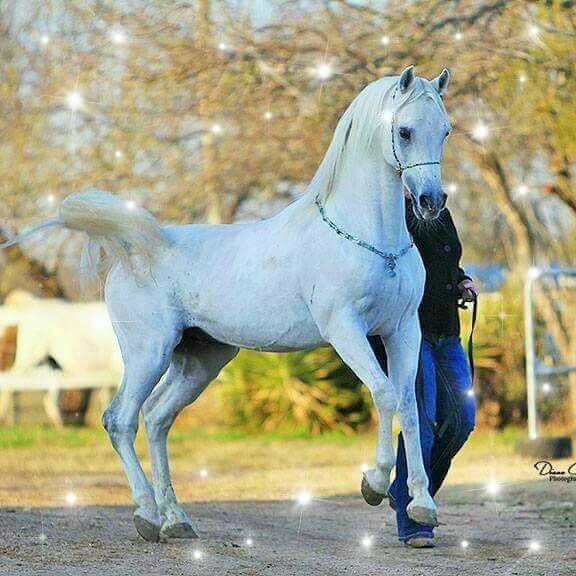
08 March, 2021

AK El Hassan

AK El Hassan (*Ibn Moniet el Nefous x Bint Fa Dena)

AK El Hassan, a 1977 bay stallion was out of Bint Fa Dena, a 1966 *Ansata Ibn Halima daughter out of Fa Dena, a straight Babson Egyptian mare who traced to *Bint Serra I in the tail female line of both, her sire and dam (Fa-Serr x Khedena). The matriline of *Bint Serra I, in straight Babson Egyptian form, no longer exists. The only way that a breeder can utilize the matriline, in straight Egyptian form, is through a horse that combines the Bint Serra matriline with newer Egyptian blood, for example, AK El Hassan, one of the horses produced by Jarrell McCracken of Bentwood Farm, who had purchased Bint Fa Dena from Robert Cowling and then, bred her exclusively to his EAO-imported stallion, *Ibn Moniet el Nefous.

In the resources that I have available to me, AK El Hassan, a proven breeding stallion, sired almost 50 get and through the present day, is represented by at least, 425 descendants. Approximately 58% of his get were mares (28) and 42% were stallions (20). What's interesting is that of the 48 get he sired, 19 of the 48 foals (40%) were produced by 7 mares and of these 7 mares, 3 mares share common ground through the Babson elements in their maternal line, the 2 Julyan daughters: Julyanne and Juseneh, plus AK Besatina (*Refky x Masada Saafana). These 3 mares were complementary with the Babson elements present in AK El Hassan's maternal line. Some of my favorite horses at Bentwood Farm were the straight Babson Egyptian mares /*Ibn Moniet el Nefous crosses and using AK El Hassan, in my opinion, was an indirect way of doing just that. However, in crossing AK El Hassan with sources of older Egyptian blood, including the rarer ancestral element of the stallion, Gulastra (Astraled x Gulnare), intensifies the cross of new and old blood. It's not only clever, it's an interesting combination, that is, the widely available Moniet el Nefous blood, uniquely blended with multiple sources of Ghazieh blood that you don't frequently find in the pedigrees of straight Egyptian horses. Think of the outcross possibilities, if breeders were to continue breeding in this way.

*Aminaa, an Albadeia-bred mare, was bred four times to AK El Hassan and her daughter, Halabi (by AK Shah Moniet) was bred to AK El Hassan three times! What is interesting about the mare *Aminaa, is Rabiaa (Beshier x Rateeba), who traces to the mare, Ghazieh, through the tail female line of her dam and sire. Again, these are rarer, alternative sources of this bloodline, that complement the sources present in AK El Hassan's pedigree, while adding the lines of horses who are not as widely represented in the straight Egyptian gene pool.

The Gleannloch-bred mare, Atrab, sired by Bahim Hisan (Ibn Morafic son) and out of Nagiba, was bred to AK El Hassan 3 times, producing 2 daughters: Abydoss and Baraka Atrabi plus a son, Baraka Ibn Hassan. What's particularly interesting in this cross is Nagliah, an *Ibn Hafiza daughter out of *Nabilahh, combined with the stallions Mashhour, Gassir and the Nazeer son, Hassan. It seems that *Morafic is the anchor in the pedigree, on both sides.

The mare, *Lancer's Rabha (Kayed x *Noosa), whose tail female line includes the mare, Om el Saad, was bred once to AK El Hassan, producing the stallion, Ravenwood Hassan in 1988. However, *Lancer's Rabha's daughter, Ravenwood Hamaisa by RG Al Mone (Alcibiades x RG Anemone) was also bred to AK El Hassan, producing the mare, Ravenwood Hope in 1994. What I also found interesting is that Julyanne's daughters by AK El Hassan, whom we discussed previously, were incorporated into the Ravenwood program. CJ Asamah produced the mares Ravenwood Autumn by RG Al Mone and Ravenwood Magick by TSEA Magick, plus the stallion, Ravenwood Desi by Ravenwood Desire (an RG Al Mone son). While CJ Hassana produced the mares: Ravenwood Hassana and Ravenwood Cassara, both by RG Al Mone. Again, while the pedigrees of these mares infuse more Moniet el Nefous blood (the Rafter G/Pritzlaff programs), the combination of old and new Egyptian blood  includes horses that you don't find so frequently, especially blended together, providing more unique opportunities to add the influence of horses that fall outside of the more widely used bloodlines.

06 March, 2021

Tagweed


They called him classic, a legend and considered him to be the most precious of all treasures,  one of the marvels of modern Egyptian Arabian horse breeding...for all of the admiration felt for Tagweed, and believe me, the love expressed for him is truly a global phenomenon, he was beyond all of those words, as they didn't fully capture the essence of who Tagweed really was or the overwhelming capacity of love felt for him by the Egypt that loved him, I mean really loved him. Maybe you landed on this page and you are not sure who Tagweed is? Tagweed was an Egyptian Arabian horse, bred by the Egyptian Agricultural Organization (EAO) but he was more than that, his physical appearance was like "a living history book" and recalled horses of another time and despite the modern age in which he lived, deep within his heart resided a spirit of royalty, "an old soul". He really lived his destiny,  he was a King and El Zahraa was his throne and...he knew it. Contrary to popular opinion, the EAO still breeds (always has) wonderful straight Egyptian Arabian horses and Tagweed was not only the proof of it, he was the living pulse of blood that coursed through "the heartbeat" that is El Zahraa.

Tagweed was a 2004 son of the great Gad Allah (Adeeb x Omnia), out of the beloved Tee (Adl x Bint Ibtisam). In the early days of his career, Tagweed was a promising young sire, in great demand by Egypt's growing population of private breeders. As his sons and daughters matured into breath-taking horses, his siring excellence was proven and his role as a crucially important stallion and replacement for his sire, could not be denied. In an interview with Pat Canfield, published by Desert Heritage Magazine, Ahmed Hamza, chairman of the EAO said,
“I  want  to  return  the  EAO to  its  days  of  glory.  I  want  El  Zahraa  to  re-emerge  as  the soul  of  the  Arabian horse. It  must  become  the  place  where people  come  to  get  the  best  horses”.
Certainly, his words could not be any more prophetic, when one fully considers Tagweed. Bred cleverly by the EAO, his sire Gad Allah was out of the Akhtal daughter, Omnia, while his dam Tee was out of the Akhtal daughter, Bint Ibtisam. Akhtal, a very elegant grey stallion, was an important sire for the EAO, siring 55 foals, most of which were retained in Egypt. And yet, for as great as Akhtal was, Tagweed's pedigree was filled with stallions who were also vitally important to the EAO breeding program: *Morafic (Nazeer x Mabrouka) and his son, Shaarawi (out of Bint Kamla), *Tuhotmos (El Sareei x Moniet El Nefous), Anter (Hamdan x Obeya), Ikhnatoon (*Farazdac x Bint Om El Saad) and his son, Adl. One of the more interesting aspects of Tagweed's pedigree is found through Adl and his dam, Enayah and the dynamic legacy of Adaweya (Enayah's dam) hard at work in Tagweed's pedigree, that is, an Adaweya daughter (Enayah) produces a son (Adl), who sires an influential daughter (Tee) and who, in turn produces an influential son (Tagweed). It's a pattern that we find repeating over and over again, whenever you see Adaweya in the pedigree of a straight Egyptian horse. To further underscore how special Tagweed was, we find one of the most royal tail female lines in Egyptian breeding through Ibtisam (Nazeer x Mouna), whose dam, Mouna, was a daughter of the Queen of Egypt, Moniet El Nefous! This was the heritage of the horse we knew as Tagweed and the promise made by all of his ancestors, that his star would be very bright...and it was indeed.

Timeless in physique and Saqlawi by strain, possessing a strong body, coupled with the grace and elegance that is, the very essence of this strain; Tagweed embodied the characteristics one associates with Saqlawi horses, that is, a longer back, longer legs, a longer neck that was well-set, flowing like a palm frond out of powerful, laid back shoulder and a broad, muscled chest. His head was pure enchantment and like a sculpture, finely shaped with big, black eyes, a delicate muzzle and huge nostrils. He was the quintessential Arabian dream, come-to-life and for many Egyptian breeders, he became the living standard, against which, all other horses would be measured. And so, sadly, our larger-than-life champion suffered from a tumour in his throat, that made the very act of breathing challenging and at 14 years of age, he died and  the world, was painfully forced to say good-bye to Tagweed.  A year later, the living legacy that he left us with, insures that his star will continue to shine brightly and yet, the individual that charmed us, to the core of our very being,  is still missed, by all of us who knew him.

***Tagweed died in March 2018  and since then, I have been republishing my blog memorial to him. He was a very photogenic horse and there are many photos of him that are my favorite but this one photo, well, it is in another category of favorite. Many thanks to the photographer, Mohamed Abdo, as he brings Tagweed to life for me, everytime I see the photo.****

25 February, 2021

Jyar Meia Lua

Jyar Meia Lua (RFI Maktub x Jiullia El Jamaal),  the proud Arabian stallion come to life, thanks to Gigi Grasso & Arabian Essence

For many people, 2020 couldn't end soon enough. So, maybe it is a bit weird to express surprise, that here we are, almost a full year later, since Arabian Essence TV presented the quarantine video series, Stay at the Farm. So much and so little has happened over this past year, if it makes sense to say it like this.  If there is anything good to come out of the Corona Virus pandemic, Stay at the Farm is one good thing. 

I think I began to really love the show when Ferdinand Huemer of La Movida Arabians was the guest and he presented a young mare named Binta el Jyar and a stallion named Bari el Jyar. Full siblings, the two horses are sired by Jyar Meia Lua and out of the Marwan Al Shaqab daughter, Bali el Marwan.  About Binta el Jyar, Ferdinand said,
"she is very, very close to my ideal. She's huge..huge, super body, fantastic neck, incredible movement." 
At first glance, the horses appear different from each other; one is chestnut, the other is bay but when you study each horse a little more closely,  you will notice the consistency in their breed type, conformation and presence.  They are more similar, than they are different and this article, is about the special stallion, still so young and siring with consistency, across a wide variety of bloodlines.

Jyar Meia Lua, bred by the late Lenita Perroy, is a bright bay stallion, a son of RFI Maktub (Altam Yshmayl x RFI Cyntilation) and out of Jiullia El Jamaal (Ali Jamaal x Jullye El Ludjin). 

In 1971, Breyer Animal Creations, a Reeves International company, released mold #211, the Proud Arabian Stallion, sculpted by Chris Hess. Over the years, this same mold has been used to memorialize legendary Arabian horses like *Witez II and Thee Desperado. 50 years later, the resemblance between the model and Jyar Meia Lua is riveting to me. It makes me wonder about things like artist vision and inspiration, when art and life come together as one.

Jyar Meia Lua carries almost 30% Egyptian blood through the straight Egyptian horses: *Fadl, Hadban Enzahi, Malacha, *Fakher El Din, Ansata Abu Tai, Shaker el Masri, Nabiel and Ruminaja Ali. The common denominator in Jyar Meia Lua's Egyptian bloodlines is Nazeer, as he appears multiple times, anywhere from 50% (as the sire of *Fakher El Din) to 6.25% as a great-grandsire. 
Ibn Rabdan, painted by Mrs. Colmore, from the book written by Prince Mohamed Aly Tewfik, Breeding of Pure Bred Arab Horses 

However, further back in the Egyptian lines, resides a 1917 horse, Ibn Rabdan, whose influence is still relevant to the present, as it is manifested physically through the circular silhouette of Jyar Meia Lua's gloriously balanced body.  Jyar Meia Lua is very similar in phenotype to Ibn Rabdan, with his strong and smooth topline, deep and powerfully muscled shoulders, well-sprung rib cage, balanced hind end and beautifully shaped neck.  In my opinion, this is why Jyar Meia Lua has combined so well with the breeding program of Ariela Arabians in Israel, as the number of lines to Ibn Rabdan, complement those lines also present in the Ariela mares. 

What I also found interesting were the pockets of concentrated blood of a few modern horses like Ali Jamaal (37.5%), Bey Shah (12.5%)  and *El Shaklan (6.25%). In the case of Bey Shah, his dam, Star of Ofir was a *Bask daughter, which complements and intensifies the other *Bask lines in the pedigree through Toi Soldier (a *Bask son) and Coya-B (a *Bask daughter). With *Bask as far out in the pedigree as the 5th and 6th generations, it is impressive to consider the 5-to-6% influence he exerts in the pedigree. One can also point out that the blood of *Bask complements the blood of the Michalow bred mare, Dewajtis, a maternal great-grandaughter of Wielki Szlem (an Ofir son like Witraz, out of Elegantka, a tail female Gazella II) and *Naganka (a Negatiw daughter, who traces also to Gazella II and through her dam, Najada, a Fetysz grandaughter). 

I haven't even touched upon the common ground that exists between some of the Crabbet bloodlines and the horses that were exported from Crabbet and incorporated into the RAS breeding program, as well as the Crabbet blood that includes Skowronek and also found in some of the Polish bloodlines, like Negatiw.

While Jyar Meia Lua's pedigree at first glance, appears to be an outcross pedigree, uniting horses from different breeding programs and countries, on a deeper level, one finds common ground in the ancestral elements of Jyar Meia Lua's pedigree. These long ago horses who are just but a name to some, serve as connections, building bridges amongst the outcross opportunities.

15 February, 2021

Nader Al Roeya AA

Nader Al Roeya AA (Nader Al Jamal x The Vision HG)

Nader Al Roeya AA is a 2011 stallion, bred by Ariela Arabians and owned by Nayla Hayek of Hanaya Stud. He is a son of Nader Al Jamal (Ansata Sinan x Savannah CC) and out of The Vision HG (Thee Desperado x Belle Staar). Of his sire, Nader Al Jamal, Jeff Wallace of Arabian Horse World Magazine, recently posted on the magazine's Facebook page :
"some stallions are meant to be breeding horses and impose a positive influence wherever they land - therefore they build an importance around themselves. Nader Al Jamal is one of those stallions."  
I enjoy looking through the photos on Bar Hajaj's Facebook page, which is where I found the above photo of Nader Al Roeya AA. I am not sure if I can put into words what it is about this particular photo that grabbed my attention so suddenly and made me forget everything else. I mean, Bar Hajaj is one of my favorite equine photographers and it's expected that I would appreciate one of his photos and of course, Nader Al Roeya AA is so physically attractive, no surprise that he would command the full attention of anyone, including myself. His beauty is beyond compare but it's that scopiness hidden within that voluptuous multi-circular balance of beauty and classic Arabian horse type, that suggests effortlessness, ease, fluidity, sleekness, suppleness, smoothness, blended together to create something a little more exciting, a little more beautiful, a little more unique. It's in these details that one discovers quality, as defined through grace and elegance. Does that make sense?  As elusive as words are right now, how can I further explain what Nader Al Roeya means for me? My dear reader, if someone were to stop me on the street right now and ask me, point blank, to describe the ideal Arabian horse, the description I would offer them is Nader Al Roeya AA.

At first glance, you may be impressed knowing that Nader Al Roeya AA is out of one of the most celebrated and beloved mares in straight Egyptian breeding but as captivating as The Vision HG is, you would miss the unique story of this stallion's heritage and all the other horses who have a part in it, if you don't dig a little deeper. So, I went to his pedigree, directly to his tail female line and discovered Zaafarana (Balance x Samira), a 1946 mare, bred by the RAS. Her dam Samira (Ibn Rabdan x Bint Radia) was a full sister to the important stallion Shahloul and Hamdan, chief sire for Inshass. In tail female, she traces to the mare Bint Helwa, whom Lady Anne Blunt had purchased from Ali Pasha Sherif.  Zaafarana was celebrated in her time for her brilliant action and presence. She must have been electrifying, when moving. She captivated all who watched her, including Judith Forbis who once said,
"she was a mare of exceptional quality and brilliant action."
Zaafarana was an excellent producer, passing on her athleticism to her sons *Talal (by Nazeer) and Amrulla (by Sid Abouhom), who became champions and much loved racehorses in Egypt.  Six generations is all that separates Zaafarana from Nader Al Roeya. You will find the line of maternal influence through the following chain of mares: The Vision HG -> Belle Staar -> Alia-Aenor -> Hasna Al Badia -> El Ameera -> Zaafarana. For me and that of my level of understanding, The Vision HG was the extraordinary mare she was, only because she was a Zaafarana, one of the best dam lines in all of straight Egyptian breeding.

By strain, Nader Al Roeya AA is Saqlawi but it is interesting to note that he is influenced as much by the Saqlawi strain, as he is by the Hadban Enzahi strain. The pedigree unites a diverse collection of bloodlines together with a twist, as the blood of a few key individuals is further concentrated, to impact Nader Al Roeya AA in a most unique way.  It's really clever in hindsight, as it minimizes the number of horses expected within the first five generations of a pedigree. In this case, what should be 62 horses populating the first five generations is actually 45 horses, as 8 horses appear more than once in the first 5 generations, thereby increasing the contributing influence of  each of the 8 horses. For example, the 1984 stallion, The Minstril (Ruminaja Ali x *Bahila) appears four times in the pedigree, twice through his son, Thee Desperado and also, through two of his daughters: Belle Staar and Miss Maggie Mae. He represents almost 38% influence of Nader Al Roeya's genetic heritage. What's interesting though is that Miss Maggie Mae, is out of the paternal grand dam of The Minstril, helping to boost the percentage of influence that Bint Magidaa was already exerting through her son, Ruminaja Ali, to over 20%, just shy of the influence that a grandparent would exert in another horse's pedigree.  TheEgyptianPrince, through Thee Desperado and additionally, combined with Prince Fa Moniet and Alia-Aenor, contributes a similar percentage of influence. However, when you combine TheEgyptianPrince with the other sources of Moniet El Nefous blood, that percentage increases, just under 30%! As far as outcross blood is concerned, it is very small; primarily through the mares Fada (Fadaan x Aaroufa) and El Ameera (Nazeer x Zaafarana), both at a little over 3% each. One can make a case for Ansata Abu Sudan, introducing the blood of his dam, *Ansata Bint Misuna (Nazeer x Maysouna) into the mix and separately, the mare, Ansata Delilah, who introduces the blood of her dam,*Ansata Bint Misr (Sameh x *Ansata Bint Bukra), however, these individuals are further out in the pedigree and by their generational position, contribute a very small percentage of genetic influence, as compared to the other horses named previously. In deciding whether Nader Al Roeya AA is the right choice for your mare; you really need to focus upon the key individuals in the pedigree, study them and understand how their influence will complement the genetic influence of your broodmare. For example (my opinion), if I were to consider him as a suitable stallion choice, it would be because my mare(s) are strong and loyal to their strain, Kuhaylah Rodaniyah(s), with very little or no Thee Desperado/Minstril/Ruminaja Ali or Moniet el Nefous blood. Not that what I am writing to you dear reader is offered as a magic formula of success but rather, I say this more for the opportunity to develop unique combinations of widely-used bloodlines, in conjunction with other bloodlines that may not be so wide-spread (pockets of outcross opportunities). And, since we are discussing how to best use this horse's genetic legacy, can I add in closing that Nader Al Roeya is a proven breeding stallion and has been standing at stud with Uri Shaked Training Center since 2020. 

As I wrote in the blogs for Simeon Sebedee, *Hadban Al Shaqab, Thee Revolution, Fa Ali Bey and *Nebras Al Rayyan, no horse lives forever and the same reality that exists for all of these named stallions, also exists for Nader Al Roeya, whose own sire, Nader Al Jamal, tragically, died too soon. Nader Al Roeya AA is now 10 years old. In this community, I have seen too many really good stallions die, underused at stud, only to read breeders quickly express their "if only I had...". Well, here's a "heads-up" from me to you dear breeder...NOW IS THE TIME. Nothing lasts forever, not even Nader Al Roeya AA. Will you be ready when forever gets here? 

01 February, 2021

Simeon Sebedee


On the very first day of February, what can I possibly offer to lighten your heart, mind and soul dear reader, in what has truly been so far, a winter of discontent? 
"When a condition or a problem becomes too great, humans have the protection of not thinking about it. But it goes inward and minces up with a lot of other things already there and what comes out is discontent and uneasiness, guilt and a compulsion to get something--anything--before it is all gone." - John Steinbeck, The Winter of our Discontent
Now that January is behind us, do you realize that in less than two months (more like 48 days but who is counting), spring will return and so will the leaves on the trees, the green grass, warm breezes, the flowers and the songbirds? Do these words lift your spirit? If not, then think of the foals who will be born, the mares who will soon be bred, the new show season and more and more people will be vaccinated against the Corona Virus and life, hopefully, will slowly start to be good again! There is so much to look forward to, even if it appears not to be so at the current moment. I know, I know. I struggle like you to make sense of what really doesn't make any sense at all.  I am grateful for the horse, even in challenging times, he lifts the soul to a higher place than it was before but still, it's not easy and sometimes, we need to work at it, even with the horse's help. I promise you, if you allow me to continue, this particular blog will lift your spirit, if only for the few minutes that you spend reading the story of a fascinating horse.
 
Simeon Sebedee is a 2006 stallion, a son of Imperial Madaar (Imperial Madheen x Ansata Nile Mist) and out of the extraordinary chestnut mare, Simeon Sehavi (Asfour x Simeon Sheba). He was bred by Marion Richmond of Simeon Stud in Australia. I haven't checked Arabian Essence TV in a little while and the channel has uploaded new videos from very recent shows like the Bahrain Straight Egyptian show, the Bahrain Breeders show and the Qatar National Arabian show, which is where the video of Simeon Sebedee was taken. He was shown in the 11 year old and older stallion class, where he placed 2nd to Gazwan Al Nasser, a Gazal Al Shaqab son. The scores between the 2 horses varied by only one point and Mr. Rombauer gave Simeon Sebedee a perfect score for movement too!

Now, for some much needed housekeeping before we continue with our story. This blog, all for the love of a horse... is not sponsored by ArabianEssenceTV, despite mentioning them as frequently as I do. I am extremely grateful to ArabianEssenceTV for making the videos of the individual horses available. If you enjoy watching Arabian horses of all bloodlines and you have the ability to connect with You Tube, ArabianEssenceTV makes it so easy to experience each show.  You can pause on a frame, rewind, play in slow motion, everything you need to help you arrive at your assessment of any horse that catches your eye. It's a really huge gift that ArabianEssenceTV gives to Arabian horse enthusiasts all over the world, bringing horses to our consciousness that perhaps, without ArabianEssenceTV, we would otherwise, not know the horse even existed, like Simeon Sebedee. 

I was scrolling through the new video uploads, part of me not sure that it was what I wanted to do, when the name "Simeon" grabbed my attention. I am not sure what impressed me first: the willingness or rather, the earnestness that this horse possesses in trying to do what is being asked of him or his outrageously beautiful body. He is so close coupled! If a horse can be divided equally into thirds, as Carl Raswan once suggested, then it's that interior circle that just throws me into another sphere of delight. His barrel, well-sprung rib cage, the depth of his heart girth, the width of his back and the overall muscling are all splendid. I can't think of another horse more perfect in this area than Simeon Sebedee is. 

Simeon Sebedee is overwhelmingly Hadban Enzahi-influenced (that is his strain by the way, as through his damline he traces to Venus, the root mare of the strain), approximately 40% of his pedigree is influenced by Hadban Enzahi-strain horses, however, on a secondary basis, he is also influenced equally by the Saqlawi and Dahman strains, approximately 25% of each strain, which explains the refinement I see within an overall, masculine, substantial body. Through my friend and mentor, Marilyn Lang, I have learned to appreciate the presence of *Bint Serra I (Sotamm x Serra) in a straight Egyptian pedigree and this particular Saqlawi mare exists in the pedigree of Simeon Sebedee.  As a matter of fact, she is part of an intensified Saqlawi strain cross that  finds *Bint Serra I, combined with the Saqlawi line of *Tuhotmos, through Om Khamsa, a 1974 mare bred by Jean Jennings of Ra'adin Arabians. Do you know that she was named "Om Khamsa", in honor of "Khamsa", a straight Babson Egyptian mare sired by Fay-El-Dine (Tail female *Bint Serra I) and out of Khedena (also tail female *Bint Serra I)? Khamsa is the maternal great-grandam of Om Khamsa, by the way.
In the video, did you notice how Simeon Sebedee lifts his left hind hoof during the hard stance? That is eerily similar to  *Tuhotmos, who also lifted his left hind hoof, when  he asked to stand up!

Om Khamsa is the paternal granddam of Simeon Sheba, as she foaled Ra'adin Royal Star, the sire of Simeon Sheba. Personally, I am also fond of  Om Khamsa's other progeny, like the mares, Masada Fa Khedena by Fabo and Ra'adin Madonna by Ibn Morafic. One of the reasons that I love this cross so much is the concentration of the Prince Mohamed Aly Tewfk breeding program primarily through the  horses  that were imported to America like *Fadl, *Maaroufa and *Nasr.

To underscore the significance of Simeon Sebedee's tail female line, which through Simeon Sheba, includes the world famous Simeon Stud broodmare, 27 Ibn Galal V; in an interview with Samantha Mattocks of The Arabian Breeders Magazine, Marion Richmond explained how in 1975, with her parent's permission, she sold all of her horses (with the exception of Simeon Shirli) to focus instead on breeding horses closer to her ideal. Traveling all over the world in search of the perfect horse led her to to straight Egyptian horses and shortly thereafter, Marion purchased 27 Ibn Galal V. In Marion's own words, she states, 
"I was with Dr. Hans Nagel at the time and he both helped me and encouraged me with her purchase."
Asked within the same interview for key successes, Marion did not hesitate in naming Simeon Sehavi as one. In Dr. Hans Nagel's newest book, The Arabian Horse: Nature's Creation and the Art of Breeding, one finds the synergy that exists between these two breeders. Speaking about 27 Ibn Galal V, Dr. Nagel states,
"Also, the Simeon Stud in Australia was fortunate to buy a first class mare from Babolna, 27 Ibn Galal V. Her sire was the imported Ibn Galal, bred to the Egyptian mare 'Hosna'. This liver chestnut mare was of outstanding quality, and without doubt, she was largely responsible for the world-wide success enjoyed by Simeon Stud particularly when she was mated to the Katharinenhof-sired Asfour (Malik x Hanan). This mare was the first Australian National Champion mare and at a special 25 year celebration of the Australian Championships her granddaughter Simeon Sehavi (Asfour x Simeon Sheba) was also awarded the title of National Champion Australian Mare."
Simeon Sebedee has a full brother, the chestnut stallion, *Simeon Ibn Sehavi, a full year younger than Simeon Sebedee, which is good news for American straight Egyptian breeders. Although *Simeon Ibn Sehavi differs greatly in phenotype from Simeon Sebedee, it's a chance to incorporate the same genetic crosses, that were it not for DeShazer Arabians who imported him, may not exist in America. I think, but am not sure, that there may be another full brother, the 2008 stallion named D Fares, who appears to  have been an in utero foal, when the Dubai Stud purchased Simeon Sehavi from her breeder.
Simeon Sebedee is now owned by Al Aqeed Stud. Simeon Sebedee is a proven breeding stallion. His son, Wazeer Al Aqeed, out of Mabrouka Al Faya (sired by an Alidaar x RN Farida son, crossed upon EAO bloodlines), was shown in the yearling colt class of the Qatar National show. Interesting that the movement of this colt, earned the colt a higher place in the standings. It is exciting to see Simeon Sebedee's legacy (and that of his beautiful dam) carried forward into the future, so that other breeders can enjoy the promise offered by his genetic heritage and also, the work of dedicated breeders whose broad vision for the Arabian breed, made these horses possible.

I know that for some people who may read this blog, they may not understand the attention that I am paying to Simeon Sebedee because he placed second to another horse in a small class or maybe, because he didn't place in the overall Senior Stallion Championships. For these people, the show ring wins, not knowledge born of study, are more significant and an affirmation of quality. In a way, I can understand that, as everyone has a desire to be recognized as a "winner". However, what may appear initially as "winning" may not actually be that at all, five, ten, fifteen years from the big show ring win.  In an interview with Monika Luft, published by Tutto Arabi and available on the website, Polskie Araby, Sheikh Hamad Bin Ali Al Thani, offers a different perspective to shows, points, first place/second place, championships and such; that is, how will any horse, show ring winner or not, if incorporated into your breeding program, produce the type of horse that you desire? 
"We went to many shows but we never stayed until the championships. We did not care about the champions because we already picked the horse we liked. I remember Sheikh Abdulaziz or Sheikh Nawaf, all the old friends, we talked later in the car about the horses that looked nice and that could fit our breeding and could be maybe fifth in class, not necessary be the winners. OK, we loved the horse who won, but did not care. It was important for the owner but not for us."- Sheikh Hamad Bin Ali Al Thani
As I wrote in the blogs for *Hadban Al Shaqab, Thee Revolution, Fa Ali Bey and *Nebras Al Rayyan, no horse lives forever and the same reality that exists for these horses, also exists for Simeon Sebedee, who is now, 15 years old. In this community, I have seen too many really good stallions die, underused at stud, only to read breeders quickly express their "if only I had...". Well, here's a "heads-up" from me to you dear breeder...NOW IS THE TIME. Nothing lasts forever, not even Simeon Sebedee. Will you be ready when forever gets here?

25 January, 2021

The Vulnerability Hidden Behind A Number

Aleah Noelani (*Fayad Al Shaqab x Hadaya Nemrah) 2021 filly bred by Robin Lee, Aleah  Arabians
I remember reading an article within a popular monthly equine magazine that at the time, reported on the worsening horse market and how 100,000 broodmares were going to suddenly, become unemployed and find themselves in search of homes, at a time when the supply of horses exceeded the demand.  As a point of reference, The American Horse Council reported 9.2 million equines living in America, circa 2003.  So, 100,000 broodmares represents one percent of the total equine population. At the time, the number of 100,000 seemed gigantic to me and I spent alot of time wondering what it would look and feel like, if you gathered 100,000 horses, all in one place, all at one time. Would there even be a venue large enough to hold that many horses all at once? I couldn't stop thinking about each individual mare and how unfair life can be to horses.  Once, these mares were highly esteemed, their value defined by her role in producing foals that created and established profitable markets for their owners. Once the money dried up and those lucrative markets disappeared, so did the esteem felt for their mares. It was easy for these owners to get rid of them, in order to get out from under the expense of keeping them. And for me, that's the greatest tragedy, the absence of affection, within a relationship that should have been experienced on a deeply intimate level, between two species. I imagine these mares as foals, so irresistible for anyone, even for people outside of the horse community. Now mature horses, maybe not as lovable as the foal, I find myself thinking once more about them, still vulnerable, helpless and unprepared to meet their fate, at the hands of the people who bred them. If there is one thing that horses have taught me about life, it is that life, really is a miracle. When that newborn foal is delivered safely, without injury to his dam, life is a profound and humbling event. I am embarrassed to say that I took life for granted and I was part of the problem.  Uterine infections, poor semen motility, reabsorption, fibrous uterine walls; I learned how delicate, how frail, how precious new life really is. It doesn't always happen, no matter how much we want it to. Even that really scary, black spider that causes me to become light-headed when I see it, is a living miracle. Life is sacred, in all forms: the good, the bad and the ugly. So, where am I headed, you ask? All this came to mind, when the deaths from Corona Virus in America surpassed the even larger number of 400,000 late last week. And if that number doesn't hit you like a ton of bricks and brings tears to your eyes, the CDC expects another 100,000 people to die from the virus over the next 4 to 5 weeks. Like the 100,000 broodmares, what would it look like to be in the same place where 400,000 - 500,000 people are assembled together? I don't do well in crowd situations but I would endure it 100 million times, if it meant that we could get the 400,000  people back. And what about the 100,000 expected to die over the next month? That news made the hair on my head stand on end. Will I be one of the 100,000? Will it include you, dear reader? That's the new reality that we live in. In the face of the new variant strains of Corona Virus, recently discovered by UK scientists to be 30% deadlier than the strain we dealt with last spring, anyone of us is susceptible to infection. At the time that I am writing this blog, one American is dying from Corona Virus every 30 seconds. So, dear reader, it's challenging for me, on a deeply personal basis, to blog about horses when so many people are dying, every day. It's difficult to rave about a particular horse, lament about horses that should have been bred together that weren't, a breathtaking performance at a show or bloodlines that are in danger of disappearing from our community, when deep in my heart, I recognize that another beautiful human being, died before reaching their true potential in this world. The world is less brilliant without this person in it. And, to make it even more sorrowful, they died alone, without their loved ones by their side. How can I reconcile all these feelings, on a moral, ethical and spiritual basis? Yes, I am struggling with life's injustices, especially for those who are so vulnerable and helpless, like the 100,000 broodmares I mentioned at the beginning of the blog. Who will speak for the Corona Virus victims? Who will remind others of the special person that existed just a few weeks ago? Who will console the families that these people left behind? So, please forgive me, for my reduced activity level within the confines of this blog. I'm not going away, I'm just struggling to understand and accept the tragic loss of life that for now, knows no ending. Promise me, that in the next few weeks, you will wear a mask when you spend any extended time indoors with people who are not living with you, in your household. Make sure that your mask has multiple layers of fabric or if not, wear two masks.  Pay attention to the CDC standards. Do everything in your power to prevent infection, until you are able to receive the vaccine. Your life is precious and without you, this world will grieve the loss of your unique, beautiful and miraculous life. 

10 January, 2021

*Nebras Al Rayyan

*Nebras Al Rayyan (Ansata Hejazi x Naama Al Rayyan) as photographed by Brandy Phillips
There really isn't another horse bred quite like *Nebras Al Rayyan in North America. He is a son of the "King of Kuwait", Ansata Hejazi (Ansata Halim Shah x Ansata Sudarra) while his dam, Naama Al Rayyan (Safir x Ansata Majesta) was a full sister to the multi-champion and beloved Qatari-bred stallion, Ashaal Al Rayyan. Genetically, *Nebras Al Rayyan offers the straight Egyptian breeder a pedigree that is somewhat different and increasingly rare in our community - that is, in a post-Ansata age, *Nebras Al Rayyan is primarily an Ansata-bred stallion (75% Ansata breeding) with NO Prince Fa Moniet blood! Therefore, one of the most important things that I can say in this blog about *Nebras Al Rayyan is that in one horse, the majority of the pedigree represents the Ansata foundational bloodlines: *Ansata Ibn Halima, *Ansata Bint Bukra,  *Ansata Bint Misr, *Ansata Bint Mabrouka and *Ansata Bint Misuna. The 25% of *Nebras Al Rayyan's pedigree that falls outside of the Ansata foundational bloodlines reflects the breeding programs of Dr. Hans Joachim Nagel, Katharinenhof in Germany (18.75%) through the horses - Salaa el Dine & Aisha; plus the sire of Ansata Malika: *Jamil, while the dam of Ansata Malika, JKB Masouda (Madkour x Maymoonah), was a mare bred by Jean Kayser of Belgium, who was leased by Ansata. She contributes the remaining 6.25% of influence in the pedigree.
*Nebras Al Rayyan, as photographed in January 2015 by Diana Cantey
The name "Nebras" in Arabic means "light", as in the electromagnetic radiation perceived by a human eye or simply said, a source of energy harnessed within the flick of a switch, the flame of a candle or the rays of the rising sun to brighten what once, was dark or absent of light. It's especially significant to me that this particular horse's name translates to "the light of Al Rayyan Farm". Think about this for a second. His name reflects the feelings that he inspired within his breeder at birth. I can use a million words to describe the significance of *Nebras Al Rayyan and yet, all my words would fall short of the transforming power held within the meaning of his name.  Foaled in 2006, *Nebras Al Rayyan is now 15 years old. When so many of the Hejazi sons have been sold overseas and are now, out-of-reach for American breeders; it is somewhat of a miracle for American breeders to have access, on our shores, to a breeding stallion who also incorporates the bloodlines of many of the American-bred Ansata mares who are not as available to American breeders, as they once were. 
*Nebras Al Rayyan, as he appeared on the Arabian Horse World cover in October 2011, Carol Maginn photo

As previously stated, *Nebras' maternal grand-sire is the Salaa El Dine son, Safir, out of the Ansata Halim Shah daughter, Aisha, a Ghazala (Ghazal x Hanan) daughter. When Safir matured into a marvelous breeding stallion, surpassing​ the expectations that had been held for him, Al Rayyan incorporated four of his daughters into the breeding program: Mabrouka Al Rayyan, Turkiya Al Rayyan, Al Wajba Al Rayyan and Naama Al Rayyan, the dam of *Nebras. In the December 2002 issue of Arabian Horse World magazine, Susanne Boesche, in her feature for Al Rayyan Farm, described Safir as: 
"Big, dark eyes in a chiseled face, he is attentively watching the surroundings, his neck is proudly arched, his tail carried high, and small, hard hooves are stamping, self-assured on the ground - an appearance that he might have inherited from his father, Salaa El Dine (Ansata Halim Shah x Hanan)."
The maternal lines of both the sire and dam in Ansata Hejazi's pedigree are noteworthy. It's much more than just saying that both the sire and dam have a tail female line to the EAO mare, Bukra, although in our breed, it is our tradition to honor the influence of our horses, through the lineage of their dams. In Ansata Hejazi's pedigree, each dam (maternal and paternal) is a result of blending Ansata Shah Zaman (*Morafic x *Ansata Bint Mabrouka) with the bloodline of *Ansata Bint Bukra. (Nazeer x Bukra). In the case of Ansata Rosetta, it is *Ansata Bint Bukra herself, while with Ansata Delilah, she is a result of breeding Ansata Shah Zaman to *Ansata Bint Misr (Sameh x *Ansata Bint Bukra). Combining Ansata Hejazi with Naama Al Rayyan, multiplies the lines to *Ansata Bint Bukra, who now, appears 5 times in *Nebras Al Rayyan's pedigree. A 6th line to Bukra comes by way of the stallion Ghazal, the maternal great grandsire of Safir. Ansata Hejazi offered breeders a very concentrated source of blood to Bukra. Now, it is only through his sons and daughters, like *Nebras Al Rayyan, that we are able to tap into this rich resource of Bukra blood.

Ansata Majesta (Ansata Halim Shah x Ansata Malika) is the dam of Naama Al Rayyan, a full sister of Ashaal Al Rayyan and the mother of *Nebras Al Rayyan. Ansata Majesta was much loved, as she enchanted everyone with her great beauty. Do you know that at the Qatar International Show, she was named Champion or Reserve, every year from 1991 to 1999! 
*Nebras Al Rayyan, at home, enjoying life as a horse

Sometimes, in the fraction of a moment, one horse will remind you of another horse from another place, another time. If you are lucky, you might capture this moment through the lens of your camera. With 4 lines to Ansata Halim Shah (50% of *Nebras' pedigree is influenced by this stallion), no surprise to see that *Nebras Al Rayyan looks alot like his grandsire, great grandsire and twice great-great grandsire. 

*Nebras Al Rayyan is a proven breeding stallion and in the resources that I have available to me, I found 16 registered foals (14 American born, 1 Belgium born and 1 Qatari born) which breakdown as follows: 8 mares, 6 stallions and 2 geldings, primarily out of a diverse group of straight Egyptian-bred mares and one Polish-bred mare, Pustynna Tarcza, a Pamir (*Probat x Parma) daughter. Carol Maginn, *Nebras' owner, shared what she feels are *Nebras' strength as a sire and what he personally means for her program,

"Nebras brings to our program extreme exotic type and refinement...He is an exceptionally beautiful stallion with great legs, flag tail carriage and charisma." 
Bred to a Halim el Mansour (*Ansata Ibn Halima x RDM Maar Hala) daughter, out of an Ansata el Sherif great-grandaughter, *Nebras Al Rayyan sired a beautiful filly, Fa Bint Savanna Moon, for long-time straight Egyptian breeder, Marilyn Lang of Fantasia Arabians, in 2012.  She remains one of my favorites of the *Nebras-sired foals.

Fa Bint Savanna Moon (*Nebras Al Rayyan x Fa Savanna Moon) as photographed by Suzanne Sturgill

As I wrote in the blogs for *Hadban Al Shaqab, Thee Revolution and Fa Ali Bey, no horse lives forever and the same reality that exists for the horses we discussed in November 2020, also exists for *Nebras Al Rayyan, who actually, is a "cousin" to Hadban Al Shaqab. In this community, I have seen too many really good stallions die, underused at stud, only to read breeders quickly express their "if only I had...". Well, here's a "heads-up" from me to you dear breeder...NOW IS THE TIME. Nothing lasts forever. Will you be ready when forever gets here?