08 September, 2014

Bedouin Beauty: Asalah

"The head is more important in Arab horses than in other breeds....the really perfect head being only seen in the horses of purest blood..." - Lady Wentworth, from her book, The Authentic Arabian Horse
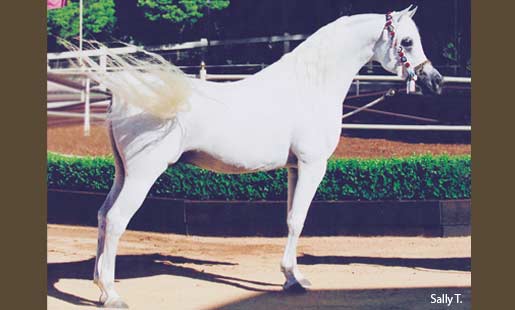
The mare pictured is Maar Mara, a straight Egyptian Arabian, of Babson and Hallany Mistanny ancestry. She was bred by the late Jay Gormley and is currently owned by Marilyn Lang of Fantasia Arabians. She is a beauty.
BUT
This blog is not really about Maar Mara. It's more about a quality that Maar Mara possesses that I wanted to point out. The most excellent blog of Edouard al-Dahdah, Daughters of the Wind, is visited sometimes by a guest blogger, a Bedouin named Pure Man, who once wrote about the prominence of the facial crest bone and the esteem that the Bedouin felt for this breed hallmark. See the white arrows that are pointing to each side of her face?
"Among the Arabians the KUHAYLAN (masculine type) has the shortest and widest (broadest) head with the most details (fine tracery of veins, wrinkles, 'bumps', bulges, 'tear-bones', etc.) 'engraved' upon its intelligent features." - Carl Raswan, from his article, The Head of the Arabian, published by Western Horseman magazine
Those are her facial crest bones or as Raswan explains, "tear-bones." If you can magnify the picture, can you see how prominent this bone is? Can you appreciate the width or the degree of the flare (protrusion) of this bone? The prominence of this bone is unique to Arabian horses. If you were to lay your thumb on this area, as a way to measure the width of this bone, the distance would approximate close to the full width of your thumb. In Bedouin breeding, the prominence of the facial crest bone is an important selection criteria. The Bedouin believed that the prominence of the facial crest bone was a clear indicator of authentic origin and horses with a more prominent bone were the horses selected for breeding, among other cherished characteristics.

EnJoy,
Ralph

05 September, 2014

Barn Coat

I remember when I purchased this coat. I had gone to the store to buy something else and I walked by the outerwear section and there it was. I must have picked it up a hundred times, only to change my mind each time and place it back on the rack. 
It's not me. 
I'm too short. 
It's too long.  
It's lightweight.
I'll be cold in it but...it had deep pockets.
BIG pockets.
I could fit a lot of cool stuff in there, like a couple wormers plus a few carrots, a hoof pick, curry comb, syringes and a rolled up lead rope. And that was just for starters. Maybe even a rock or two. I love rocks. I pick them up off the ground all the time. It just seemed to me that there was alot of potential in those pockets. So, I bought the coat...yup, for the pockets. I love pockets. 
And wait, 
I have to be honest with you. I also bought the coat because, 
well, 
I thought I looked like the Marlboro man when I tried it on. 
You know, a cowboy. 
I always wanted to be a cowboy. Just like Johnny West. And Thunderbolt. You can't forget Thunderbolt. He was the best part. But this coat needed some serious character before any of that could happen. Over the years, it's gotten a lot of character. With two horses, you can imagine how much character this coat has gotten. My kids are embarrassed to be seen with me in public, if I am wearing this coat. "Please, can you wear something else" or "It's not that cold out, really, you don't need to wear it" or "you really need a new one, you look like a homeless man with that old coat, it's gross" they tell me with painful looks on their faces. It's a sore point in my household. But I love this coat and even if I were to win the big Lotto prize tomorrow, I would still wear it. I'll never get rid of it. This coat smells like my mare, Maarena. I bury my face in the coat and it takes me back to when I was standing right next to her, with my face buried in her silky mane. How I loved those days. Did I really understand how fleeting that time was? I was so happy then.  Every now and then, on the really bad days, I'll hug it and  I can almost feel my arms wrapped around her neck. I didn't want to let go. 
I didn't want to say good bye. 
I wasn't ready.  
Please, stay with me. 
Don't leave me. 
Please. 
So that's why I can't get rid of my coat. It's full of...character. My mare's character. I see her in this coat. That's why I can't wash it either. I see all the smudge marks from when she rubbed her head on my arm, after I wormed her. At the time, I wasn't thrilled with all that white paste that I thought would never come out but it did...sort of. And that time that she choked and all that stuff came out of her nose. That came out too. And when I needed a cloth to wipe her face and I couldn't find one and only a sleeve would do, well, that stuff came out too. It's a really good coat now. It's been repeatedly baptized by stuff, over and over and over. Why, I would say that it fits me perfectly now. Thanks to all that character and...stuff.

10 August, 2014

Bedouin Beauty: The Soulful Eye of the Arab Horse

"The first thing an Oriental looks at when buying a horse, is the head. They look for a head full of elegance, beauty and expression. They then look at the hindquarters, and if these are satisfactory they turn their attention to the legs. These are the three most important considerations." --- Prince Mohamed Aly Tewfik, from his book, Breeding Purebred Arab Horses
"....large liquid dark eyes of oval shape set deep down towards the middle of the skull." - Carl Raswan
Pictured above is the mare, Al Amal AA, a daughter of Halim Shah I and out of The Vision HG, she was bred by Chen Kedar of Ariela Arabians and owned by Kathrin Hampe Klingebiel of EOS Arabian
"The eyes are set low on the head, usually at the line which separates the upper and middle thirds. They should be large, prominent and almost oval in shape. The size of the white are of the eyeball should not be large in comparison to the black part. Eyes with too much white take much of the beauty of the typical Arabian eye."-- Dr. Ameen Zaher, from his book, Arabian Horse Breeding and the Arabians of America
 Pictured above is the deceased straight Egyptian stallion, Ansata AlMurtajiz, a son of Ansata Hejazi and out of the mare, Ansata Samsara.
"The eye should be extremely large and dark...It should be a large blunted oval, very wide open and put into the head like that of a gazelle, and set so that when the head is in a normal position the lower edge is almost exactly horizontal." -- Lady Wentworth, from her book, The Authentic Arabian Horse.
Pictured above is the mare, Saniyyah RCA, a daughter of Mishaal HP and out of the mare, My Shooting Star.
"The indwelling gentle spirit of Arabian horses finds expression in their intelligent, sympathetic features, the glory of their beautiful countenance and in their soulful eyes." - Carl Raswan
 The late Badrilbdoor Ezzain, a daughter of NK Qaswarah and out of the Ansata AlMurtajiz daughter, Azhaar Ezzain.

04 August, 2014

GODZILLA

It has been 7 months since Mimi died. In some ways, it feels like yesterday and in other ways, it feels like it happened years and years ago. Does that make sense? On most days, I am okay. Really.

  "time heals all wounds"

I have heard someone say this before. I have always disliked this saying. As a matter of fact, I despise any cliches and would gladly ban them from human language, if I could (or honk the loudest horn, every time someone says one). No matter how heartfelt, this expression sounds HARSH and UNCARING. And yet, as more time continues to pass, it really does proves the truth of these words. It's been difficult to think of Mimi without my throat constricting and experiencing the crushing heaviness that pushes any happiness out of my life. Not having horses anymore has not only left a hole in my heart, it's left a hole in my life. Half the time, I don't know what to do with myself. Like the Dutch boy in the famous story, I am struggling to fill in the holes. 

I used to be spread so thin but there was comfort, safety and security in all of my busyness. I was so focused on the task at hand, that I really didn't have time to think about anything else. Not even addressing relationships, professional and personal goals and all of those things that I felt were in disarray and screaming for attention. You know, all the stuff that I am procrastinating on. The horses kept me grounded. They centered me. Now, with them gone, I feel like I am unraveling. I know that sounds over the top and well, maybe, it is but really,
SO WHAT?
I've been dealing with it..in my own way. 

It's funny how a Google calendar reminder can prove that I wasn't dealing with any of it.
Reminder: Horses Wormed with Ivermectin/Praziquantel @ Every 2 months from 5pm to 6pm on day 3 
I needed to worm my horses. It was time. I even checked the cupboard to make sure that I still had enough Ivermectin on hand. Can you believe it? And then the startling realization, "listen stupid, you don't have horses anymore, remember?" And then, the tidal wave started to roar towards "the shores of my emotions" and my heart started to do "the Godzilla run" to safer shores. But no one can outrun Godzilla. No one. And there I was all over again, in dreadfully cold January with the vet pulling on her tail and guiding her body towards the ground, as the euthanasia drug started to take effect. My beautiful little mare lay on the cold, hard, frozen ground,  as life slowly ebbed out of her. No matter how much I try to forget, this is one of the images that haunts me. It just kills me and sends me to a bad place every time. I wish that I could just forget. But that's my problem. I don't think I am able to forget, because once upon a time, Mimi lived. To forget her death, would mean that I would forget her life. Death is part of living. One is always followed by another, right? Death teaches us how short and fragile life is. And when the absence of another causes great pain, THEN, if we think we have failed in life to accomplish anything meaningful or significant, we can be comforted in knowing that yes, we have been successful in exercising a love that knows no limits. As a matter of fact, on the same day that Google sent the reminder to worm the horses; Google also delivered my daily reflection and buried within this reflection, I read the following,
"...to realize more fully the reign of God on earth by means of sincere witness, increased mutual understanding, mutual respect for human dignity, and the exercise of a love that knows no limits."--On Our Way: Christian Practices for Living a Whole Life, edited by Dorothy C. Bass and Susan R. Briehl 
There are no coincidences in life. We are commanded to love and to love generously...everyone and everything. And if there is one truth that is able to ground me in this sorrowful time, it is love. And at the very core, the bedrock of my relationship with Mimi, was founded upon love. That's my nugget of truth. Because why else would this hurt so much if there was no such thing as love involved? I am so grateful that I was able to experience it. Every one should love like that. My Mimi, I loved that little mare.

EnJoy,

Ralph

PS I deleted the series of worming appointments on my calendar, to avoid more reminders.


12 May, 2014

Farrada


Farrada is a 1986 stallion bred and owned by Marge Rose Klasek. He is a son of Ibn Farah and out of Princess Parada. His tail female is to Dajania, a mare bred by Mohammed Pascha, a Turcoman Chief and  imported by the Blunts in 1878. His pedigree is representative of multiple crosses of the Crabbet-bred stallion, *Raffles with older desert-bred lines like the Davenport horse *Hamrah and the Hamidie Society war mare, *Wadduda. But really, it is not fair to just mention *Raffles, as this horse was a son of Skowronek and combined with the other Skowronek sired get in the pedigree like Raseyn; Farrada has approximately 55 lines to Skowronek! Closer up, you can spot names of the superstars of our breed like Ferzon, Indraff, Azraff, Gai Parada, Dunes, Gamaar, all horses who are representative of the golden era of Arabian horse breeding and showing in the United States of America. This was the time period of breeders like Frank McCoy, Dan Gainey, Jimmie Dean and Bazy Tankersley.
Farrada presents an extraordinary picture of ultimate Arabian horse type, embodying the unique characteristics that are recognized and cherished as hallmarks of the breed. At first glance, one is overwhelmed with the overall balance of this horse. Then, it would have to be the scope this horse presents in all of his 15 hands. He is impressive. His breeder says, "Everyone goes nuts when they see him in person.  He is not that big but throws size. He is a rare CMK stallion and a classic Arabian type. . He doesn't act or look his age and still gets excited when his daughter comes in heat. Would love to see more babies by him."
A closer look at this horse and it is in the details, that one finds abounding elegance and grace. The pigmentation of Farrada's skin is amazing. His skin is jet black with no pink spots and serves a dramatic contrast to his sparkling white coat. The quality of his skin is so amazingly thin, that it accentuates the prominence of the bones in his face, as well as the veins.
His eyes are of a very nice shape, larger, fully black, set lower in the head with so much width between them. The width of the facial crest bone is also very wide. This is the area below the eye and right the jowl. The Bedouin believed that the wider this flat area is, the more authentic the horse. His nostrils are elastic, clean and of a beautiful shape. His ears are short with a beautiful shape, ending in sharp points.  His neck is beautiful, with much length and set well on his powerful shoulders, connecting with the head to form a fine mitbah. It reminds me of a Homer Davenport quotation, "The neck is a model of strength and forms a perfect arch that matches the arch of the tail."
When I look at Farrada's pictures, I am reminded of what Jimmie Dean once said about Dan Gainey's breeding program, "He established quality and refinement as the Gainey trademark. He fixed a type." In Farrada, those words, said so long ago, ring true. He is a living celebration of all the treasured qualities one can find in the Gainey-bred horse.

27 April, 2014

Ansata Halim Shah: The Standard of Balance


Ansata Halim Shah
I think this is my favorite photo, taken by Jerry Sparagowski, of Ansata Halim Shah (*Ansata Ibn Halima x Ansata Rosetta). What do you notice in this photo? For me, there is so much going on. It is immediately apparent that he was a most balanced horse. Ansata Halim Shah was a horse whose overall structure was one of uninterrupted smoothness. The outline or rather, the silhouette of Ansata Halim Shah was comprised of circular lines, creating an equality of body that is harmonious, elegant and graceful. There are no sharp angles, there are no abrupt interruptions to redirect lines that are gently flowing from one, into the next. He was not a horse of bits and pieces, rather, Ansata Halim Shah was a living sum of all his parts. Nothing was too short or too long; everything was perfectly suited for his body. For many, this horse is so special and for me personally, he is the standard, against which all horses are measured. Ansata Halim Shah will always be a timeless representative of classic Arabian Horse type. He continues to be relevant in the present day. If Nazeer was historically significant as a catalyst for modern Egyptian Arabian Horse breeding, then Ansata Halim Shah is critically significant for revolutionizing classic breed type, by underscoring the crucial need for balance.

In Lady Wentworth's AUTHENTIC ARABIAN HORSE, she speaks of balance:
"Many men worry more about measurements than type, and are lost without their inch tape and their measuring standard....An 'eye' for a horse is a gift like an ear for music. It is a sense of proportion and harmony and co-relation, the power to balance the points at a glance."
Judi Forbis, his breeder and his owner, described Ansata Halim Shah as
"one of those special horses from the day he was born. He was extreme of type, as one would expect of his unique linebreeding to the very classic Nazeer daughters, *Ansata Bint Mabrouka and *Ansata Bint Bukra, as well as being sired by the Nazeer son, *Ansata Ibn Halima. Halim Shah has always been an individual. He is smart, bold, and carries himself with elegance and grace."
And a majority of people seemed to have agreed with Judi, as Ansata Halim Shah was a 1983 United States Top Ten Futurity Colt and a 1983 World Reserve Junior Champion Stallion at the Salon Du Cheval, where he was spotted by Dr. Hans Joachim Nagel. Later, Ansata Halim Shah would travel to Germany, to Katharinenhof and dramatically influence Egyptian Arabian Horse breeding in Europe, and from there, all over the world. Dr. Nagel, in his Hanan book speaks about the Ansata influence:
"The most desired attributes of the Ansata stallion are a superbly laid-back shoulder, and ideal croup and the ability, so rarely found in Egyptian stallions, to sire stallions and mares of equal quality."
Thaqib Al Nasser
Take for example a child, who has learned to color between the lines in his coloring book. His hands have filled the black-lined outline with a vibrancy of color that the lines cannot contain anymore. So, the color spills out, influencing other empty pages with equal vibrancy and fullness and yet, possessing a loyalty to the colors that one sees. Ansata Halim Shah is like that page in a child's coloring book. He remains relevant through his progeny and particularly through his sons who are hauntingly familiar. One cannot look at a horse like Al Adeed Al Shaqab or Thaqib Al Nasser and miss the unmistakeable Ansata Halim Shah look. Again from Lady Wentworth's work:
"It is always," Said Gayot, "the best shaped horse that is most consistently successful; a good sire is almost always beautiful."
Enjoy your horses,
Ralph

11 April, 2014

The Essence of Imperial Mistilll


I am grateful that there was a horse like Imperial Mistilll. How many people did she influence around the world? I saw her the last time, winter 2004. For me, it was pure delight and pure magic, to be in her presence. Like standing in the sun light, on a cold day and feeling warm. I felt good. She made me feel better. To this day, I won't forget how she let me stand next to her, while she sniffed every part of my person. I was important enough to Mistilll, that I mattered and she wanted to know who I was and what I was all about. She filled me with happiness, down to the tips of my toes and my soul sang, all the way home. She was kind, gentle and she was everything that I expected. Little did I know that this visit, would be the last. This is a somewhat bizarre time in my life, as all the great horses of my youth are disappearing. I realized that there might be some people who are not familiar with Mistilll and the horses in her lineage. The mare that founded this family at Ansata Arabian Stud is Falima, sired by *Ansata Ibn Halima and out of the Babson mare, FaHabba (a first generation daughter of the 1932 Babson Egyptian imports: *Fadl x *Bint Bint Sabbah). Falima is the dam of important broodmares, like for example, Ansata Nile Mist, who went on to found an important family at Imperial (when bred to Dr. Nagel's *Jamilll, produced Imperial Mistill, who in turn produced horses like Imperial Kamill and Imperial Saturn). When I walked the broodmare barn at Imperial, I discovered the young grey mare, Imperial Baarilllah, by Imperial Baarez and out of Imperial Mistilll. She was stunning and I knew, in the moment that I found her, that Imperial Mistilll will never be that far away.

Enjoy your horses,
Ralph