Showing posts sorted by relevance for query Magidaa. Sort by date Show all posts

10 May, 2021

Mother-to-Mother: A Story

Mahfouza (Hamdan x El Mahrousa)
Mahfouza was a 1943 bay mare, bred by the Inshass Stud. Mahfouza's sire was Hamdan (Ibn Rabdan x Bint Radia) and her dam was El Mahrousa (El Zafir x El Shahbaa), a 1937 mare bred by the Inshass Stud. El Mahrousa's dam, El Shahbaa, foaled in 1925, was a foundation mare for the Inshass Stud. An Abeyyan strain mare, sired by a Hamdani stallion, she was purchased by King Fouad in 1931. 

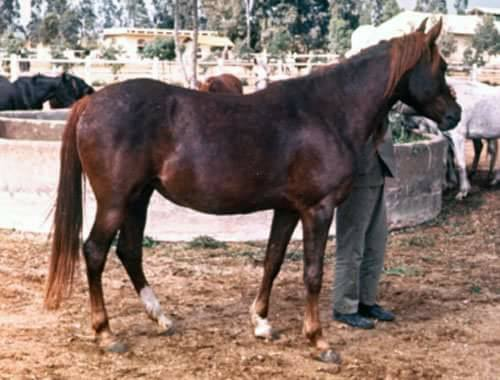
Maysa (Anter x Mahfouza)

When Mahfouza was bred to Anter, she produced the mare Maysa,

*Magidaa (Alaa El Din x Maysa)

Maysa, when bred to Alaa el Din, produced the 1964 chestnut mare *Magidaa.

Bint Magidaa (*Khofo++ x *Magidaa)

Bint Magidaa was *Magidaa's 1970 grey daughter by *Khofo++ and became one of the most legendary and prolific of all straight Egyptian broodmares through her sons, i.e. Ruminaja Ali, furthering the influence of the chain of mares starting with El Shahbaa, El Mahrousa, Mahfouza,  Maysa, and *Magidaa, all over the world.

26 March, 2023

Magidaa Al Rayyan


Have you seen the new Arabian Insider video of the 6-year old straight Egyptian mare, Magidaa Al Rayyan? She is sired by the 2002 stallion, Hilal Al Nakeeb (NK Hafid Jamil x Bint Bint Hamamaa) and out of Furat Al Rayyan (Ansata Nile Echo x RN Farida). In one pedigree, many of the ancestral elements that I have written about previously, come together, resulting in this beautiful mare. For example, Nabiel is the sire of Bint Bint Hamamaa, the dam of Magidaa Al Rayyan's sire. Nabiel is one of those horses, for whom you need to study and consider his entire pedigree (beyond the tail female line) in order to make sense of what you see physically, versus what you read on paper. An analysis of the first four generations reveals that the majority of strain influence comes from the Saqlawi strain, approximately 75%. The Kuhaylan strain, overall at 12.5%, is equally divided between the Kuhaylan Rodans and the Kuhaylan Mimriahs, 6.25% each.  The reality is that Nabiel is only Abeyyan, as much as he is Hadban Enzahi or even, Kuhaylan Rodan. Each strain accounts for a minimal percentage of 6.25% of Nabiel's pedigree. In studying the entire pedigree (and not just the tail female line), one can better connect Nabiel's airy, longer, stretchier phenotype, with that of the Saqlawi strain. 

RN Farida, her beloved maternal granddam, was foaled in 1995, a daughter of Salaa el Dine, an Ansata Halim Shah son out of Hanan. Her dam, Noha, was a Hadban Enzahi daughter, out of Nadja, a Nazeer daughter out of Nefisa (Balance x Helwa). From Nefisa, the tail female line runs through Farida to El Dahma, an Ali Pasha Sherif-bred mare, long considered to be the root mare of the Dahman Shahwan strain.

RN Farida matured into an important broodmare for Al Rayyan and for breeders around the globe. Bred to Ansata Nile Echo, she produced Furat Al Rayyan, who like her dam, has become a significant broodmare. 

NK Hafid Jamil, her paternal grandsire, took my understanding of straight Egyptian breeding to another level, well beyond a traditional understanding of selection, based on key conformational traits. I was not a fan of his sire, Ibn Nejdy, namely his pigmentation issues. Ibn Nejdy had a fabulous front end, which included a beautiful neck, well set, with a flowing line that ran gracefully from his wither (with no dip) and all the way to the poll. He had well-muscled shoulders that many horseman would consider ideal. NK Hafid Jamil, conformationally, was like his sire, a front-end horse and a celebration of all the breed characteristics that we cherish. However, from behind, the muscling was not equal, his croup was high and his hind legs were straight.The curvey, upward, gently flowing line of his neck was outrageously beautiful but so was the underline, resulting in a neck that was not heavy, it was elegant, more so than any stallion that I had ever seen before. However, the angle at which his head connected with his neck, also contributed to this look of lightness, by creating an extra-fine throatlatch. The features of his head were equally dramatic, with large, black eyes, placed lower on a head that was clean and dry, with fine skin that accentuated the prominence of bone and vein. His head conveyed what he was, a son of the desert, whose influence is now found in this daughter of the desert, Magidaa Al Rayyan. Congratulations and best wishes to the Doha Stud, her owner and to Arabian Insider, who created this beautifully moving video.

***Many thanks to Arabian Insider for making videos like the video of Magidaa Al Rayyan, available on their You Tube channel.***

27 March, 2021

Think Nabiel...Feel Nabiel

Nabiel+/ (*Sakr x *Magidaa) as photographed by Polly Knoll

For most people, there are individuals, places, events, songs, books, television shows or even, scents, flavors and fragrances that become deeply embedded within our psyche and have the power to instantly, take us back to a time period that remains memorable in our lives. When people talk about the seventies, my memories are not of gold chains, polyester pants and Saturday night fever. For me, it is a horse and his name was Nabiel+/, a 1971 stallion bred by Gleannloch Farms, a son of *Sakr, out of the mare, *Magidaa. The name, "Nabiel", is derived from the Arabic "Nabil", which means, "noble" or "high-born" as in "the son of noble parents". World famous author, breeder and noted historian of the Egyptian Arabian horse, Philippe Paraskevas within his significant body of work, The Egyptian Alternative, Volume II, wrote of  the *Morafic daughter, Enayat, the dam of *Sakr, 
"Enayat can be appraised to be 'la crème de la crème' of the Rissala branches, and most of her progeny going forward will go on to become repositories of potential, going beyond what is available anywhere else in the strain." 
In this case, I believe that Philippe has further defined "noble," by underscoring the quality of a mare like Enayat. Nabiel is noble, because the horses that came before him, were also noble. As a child in love with Arabian horses, the monthly magazine, Arabian Horse World, was like a "window" onto this world and as I transitioned to middle school, Nabiel burst onto the Arabian horse scene, through the same door that horses like *Serenity Sonbolah and Ansata Ibn Sudan had unlocked for Egyptian-bred horses. Thanks to Bill and Pat Trapp, his staunchest supporters, Nabiel continued to build upon his meteoric rise to fame, becoming one of the most magnificent straight Egyptian stallions of modern times. 

Do you know that Nabiel+/ was a United States National Champion in 1974?  In a tough, extremely competitive class of up-and-coming young stallions, the judges pinned Nabiel+/ as the winner of the Futurity Colt Class. 

Nabiel+/ came back the following year in his quest for the top prize and was named a Top Ten stallion. He made one more bid for the National Champion title in 1976 and again, went as far as a Top Ten title. Nabiel+/ was awarded the legion of supreme honor, which is symbolized by the +/ placed after his name. The achievement award is bestowed upon the horse as a result of earning 150 points, from competing and placing in AHA recognized events. Eventually, as a sire, Nabiel+/ would become one of the first Egyptian-bred stallions to sire 100+ show ring champions. In an interview with Polly Knoll, published within Desert Heritage Magazine, Joe Ferriss asked Polly to share her memories of Nabiel+/:
"Bill and Pat Trapp went down to Gleannloch and picked out Nabiel out of all the yearlings available. Bill was a great horseman and he picked right because Nabiel turned out to be exceptional. Nabiel grew to be a big horse, with a beautiful head, long neck and good overall quality. He was a big winner in the show ring at the National level but also proved a great sire no matter how you bred him. He crossed well with all lines. He was another horse who worked very well with me in photo shoots."
Nabiel is one of those horses, for whom you need to study and consider his entire pedigree (beyond the tail female line) in order to make sense of what you see physically, versus what you read on paper. An analysis of the first four generations reveals that the majority of strain influence comes from the Saqlawi strain, approximately 75%. The Kuhaylan strain, overall at 12.5%, is equally divided between the Kuhaylan Rodans and the Kuhaylan Mimriahs, 6.25% each.  The reality is that Nabiel is only Abeyyan, as much as he is Hadban Enzahi or even, Kuhaylan Rodan. Each strain accounts for a minimal percentage of 6.25% of Nabiel's pedigree. In studying the entire pedigree (and not just the tail female line), one can better connect Nabiel's airy, longer, stretchier phenotype with that of the Saqlawi strain. With all that said, our breed tradition is to follow the chain of mares in the last line of the pedigree, the matriline or the tail female line, through which, Nabiel, traces back to the root mare of the strain:
Magidaa->Maysa-->Mahfouza-->El Mahrousa--> El Shahbaa
At the time in which he lived, the Abeyyan renaissance in the middle east, driven by the progeny and grand progeny of the elite mare, Hanan, was still 10-15 years from occurring. At this time, the straight Egyptian consciousness was focused on the Dahman and Saqlawi strains. In tail female line, Nabiel traced to the Inshass mare, El Shahbaa, a 1925 mare, purchased by King Fouad of Egypt from Mohamed Ibrahim al-Hajj in 1931.  The interesting thing about El Shahbaa is that we don't know much about her. In the Inshass Herd Book, she is recorded as being sired by a Hamdani al-Nasiri stallion and out of an Abeyyah Om Jurays mare. That's it. She is one of the horses in our gene pool that we have to take it upon faith, that she is who she is written to be, until science through mtDNA can confirm or prove otherwise. 

Through the present day, Al Khamsa recognizes 2,186 asil descendants of Nabiel, with 750+ born from 2000 through 2009. That's more descendants recorded within this decade than any other. What's even more interesting about this number is that Nabiel died in 1995, almost 15 years earlier.  As I skimmed through the roster of his descendants, looking for descendants of Hanan, I found the *Jamil daughter, Ansata Vali Nile, a 1986 daughter of Ansata Nile Dawn (Nabiel x Ansata Nile Queen) especially interesting, because she combines these alternative sources of El Shahbaa together in one pedigree. Ansata Nile Dawn was sold to Jan Van Ness of Flaxman Arabians and was exported to the Netherlands, while Ansata Vali Nile was consigned to the 1987 Pyramid Society Sale and sold to Gary & Gemma Barclay of Ontario, Canada.

Nabiel crossed especially well with the daughters of El Halimaar (*Ansata Ibn Halima x RDM Maar Hala), a Rancho Bulakenyo-bred stallion, also leased by Bill and Pat Trapp. For their program, the Nabiel daughter, Arabest Nabiela, was bred to El Halimaar, producing Arabest Aziz and and Arabest Zahra. The Nabiel daughter, Arabest Nafarah, produced Arabest Halifah and Arabest Aatika. It's also interesting to learn that the El Halimaar daughter,  Arabest Halifa, was bred back to Nabiel (her maternal grandsire) which resulted in the mare, Arabest Halina. Maybe it was the success of these crosses that inspired Rancho Bulakenyo to breed their gorgeous Nabiel daughter, SF Moon Maiden to El Halimaar, producing Kachina MH. One can say that SF Moon Maiden was the foundress of the Moon family at Rancho Bulakenyo, resulting in some of the most  unforgettable horses in the Arabian breed like Abraxas Halimaar, Moon Storm MH and Maar Nabiela. There was also a 1980 mare named Durrak. She was an Ibn Morafic daughter out of Dahma Bel Najiba (Bel Gordas x Jasmyn). She was bred twice to Nabiel, producing the mares: Nadera in 1986 and Ddecadence in 1987. The interesting thing (aside from the fact that a couple of weeks ago, I blogged about Bel Gordas), Ddecadence was bred to El Halimaar, producing the stallion, Shades of Goldd in 1992. The El Halimaar son, Abraxas Halimaar was also bred to Ddecadence, producing Sunddown in 1994. Mention must also be made of the El Halimaar daughter, Maardasa, out of Hadassa (TheEgyptianPrince x Nafairtiti), who was exported to Simeon Stud in Australia. Hadassa, also bred by Gleannloch Farms, figured prominently for the breeding program of John & Joyce Hurd (the breeders of SF Moon Maiden), as they bred Hadassa to Nabiel, producing Binte Hadassa and Nadassa, who was bred to El Halimaar, producing Bint Bint Hadassa. A variation or  "twist" of the El Halimaar cross would be  through the stallion, Halim el Mansour (a full brother of El Halimaar) combined with Nadassa, which resulted in the bay filly, Halim Nada, who remains relevant in the gene pool today. The beautiful chestnut Nabiel daughter, RA Aneesa (out of the *Soheir II daughter, AK Amheir) was also bred to El Halimaar, producing the breeding stallion, WH Bodacious in 1992 for The Pyramid Society former president, Martha Lucas of White Haven Plantation in South Carolina.

One of my favorite horses of all time is the stallion, Akid Geshan, a 1986 Nabiel son bred by Alyce Burgess of the Akid Arabian Stud in Virginia. Akid Geshan is out of Akid Hanalei, a daughter of another favorite stallion, AK El Zahra Moniet and a beautiful mare who blends newer Egyptian lines with older Egyptian lines as found in the Babson breeding program, as well as the *Nasr son, Sirecho.  What is especially interesting is that Geshan has a full brother, Akid Kasim, who has 33 descendants through the present day. When Akid Geshan was crossed with his paternal sibling, RA Amber Nabiel, the cross yielded in yet another beloved horse, Arabest Samir, the 2008 Egyptian Event Supreme Champion Stallion. Actually, RA Amber Nabiel was more than just a paternal sibling of Akid Geshan, as both horses carry the blood of *Moniet el Nefous, through their dam. Akid Geshan through *Ibn Moniet el Nefous (twice) and RA Amber Nabiel through *Fakher el Din and *Morafic. 

Some of the other crosses that I also found interesting are Asasi Mashallah, a 1987 daughter of Qastal, a *Soufian daughter out of the exquisite mare, Neama. Then, there was Nahbelle, the 1986 daughter out of Masada Bellesabah, very similarly bred to Akid Hanalei but without the lines to Moniet el Nefous. Nahbelle matured into a classically beautiful mare, who became a Reserve National Champion mare of Israel. And then, there was Nagda, a 1986 mare, who is a result of Nabiel, bred to his maternal sister, Bint Magidaa (by Shaikh al Badi). She in turn was bred to Alidaar,  Imperial Imdal (resulting in the stallion, Sterling Vision), Marquis I and that's how Nagda primarily remains relevant today. Nabiel was also crossed with the line of Tamria via the Babolna-bred mare, *Pharrah, producing two sons Royal Mikhiel and Royal Pharriel. When Royal Pharriel was crossed back with the line of El Halimaar, one of the most beautiful fillies, Bint Bint Pharrah was born. Tragically, this young mare perished in a fire, before the world could know of her potential greatness.  And of course, I can't forget the Nabiel daughter, Bint Bint Hamama, who was extremely popular, through her daughter, BA Halamet, who in turn, produced treasured mares like Abraxas Habielaa and Abraxas-Halamaa. Exported to Australia, BA Halamet was bred to Saba Arabians' Ansata Halim Shah son, Thaqib Al Nasser, producing a daughter, Al Maha Al Saba.

Although bred in America, Nabiel was a son of imported EAO horses and while many of the mares that he was bred to were daughters, granddaughters or great granddaughters of EAO imported horses, those breedings reflected the bloodlines that were popular and more widely used in America at the time, however he was also bred to a variety of newly imported Egyptian mares of bloodlines that were outside of the Egyptian mainstream at the time. I compiled the following list for your review: 

From the breeding program of Sayed Marei in Egypt:
  • *Ameerat Al Badeia (Ameer Al Badeia x Naeema), producing the 1985 stallion, El Lateef
  • *Lancers Nora (Kayed x Manal), producing the stallions, Pi Prince in 1985 and Pi-Sultan in 1987
  • Nabeelat AlBadeia (Ameer Al Badeia x Meseda), producing the mare, AS Bint Nabiel in 1986
  • *Kamar el Zeman (Seef x AK Hamida), producing the 1986 stallion, DW Katar, Shams el Masabar (Madkour x Sabrah), producing the 1987 stallion, El Nour
  • *Dananier (Seef x El Amira), producing the 1986 mare, Annabiel
  • *Gamalat AlBadeia (Asil AlBadeia x Farida), producing the stallion, Flame Ibn Nabiel in 1987 
  • *Shagaret el Dorr (Kayed x Nagdia), producing the mare Shabiela in 1991 and the stallion, Shabiel KA in 1993. It is interesting that the Nabiel son, RA Jahim (out of *Masarra) was also bred to *Shagaret el Dorr, which yielded the daughters Tasharet in 1995 and Shaqaret in 1996 and *Dakilla (Bint Alia), who produced the daughters Nikilla in 1990 and Allikad in 1991. 
  • The Kheir Allah (Kayed x El Amira) daughters: *Hafaz Manal (Sasab), produced the stallions, Gasur Ibn Manal in 1985, S Tewa Nabiel in 1986, S Nambe Nabiel in 1987 and S Jemez Nabiel in 1989 and *Dakilla (Bint Alia) produced the daughters Nikilla in 1990 and Allikad in 1991. 
From the EAO:
  • ADH Saklawi Rakik (Shukri x Shooani - although the sire was bred by Gleannloch and the dam was bred by James Kline, it's all EAO breeding and the combination with Nabiel was very unique), producing the 1983 mare, Asha Kanille 
  • *Gazbeya (Nasralla x Hagir), producing the 1977 mare, Shahliel, 
  • *Masarra (*Tuhotmos x Bint el Nil), producing the mare, RA Nassara in 1986 and the stallions, RA Jahim in 1984, Kadin RA in 1985 and RA Kareem in 1987
  • *Ramses Rahwana (*Ramses Fayek x El Tahra), producing the stallion, Ramses Cawsar in 1987
  • *Dahk Al Rakessa (*Ibn Hafiza x *Barakaa), producing the stallion, Nabaha in 1993
From Germany:
  • *Hamasa Samira (Mehanna x Sadya), producing the 1985 stallion, Shaikh Zayed
  • *Shams El Ifara (Ibrahim x Shas El Faroussa), producing the 1988 mare, Nabiel Crown Jewl
From Hamdan Stables:
  • *Monicaa (Ghalion x Monaa), producing the 1986 mare, CL Moniel 
From Ahmed Sherif:
  • *Lubna (Sharaf El Din x Keshta), producing the 1985 mare, Lahib Al Hurriyat and the 1987 stallion, Azrak el Shah
While I am not suggesting that the progeny of any of these mares are more preferable over other horses; what I am suggesting is that these particular horses offer slightly different combinations of blood, which if utilized intelligently, offer outcross opportunities that can help breeders build diversity for future generations of breeders.

Nabiel was incredibly photogenic and Polly Knoll was the photographer who seemed to possess that rare ability to capture his magnetic charisma on film, in order to share it with the whole world. I have never seen a bad photo of this horse, even in casual shots. He was a larger-sized horse, approx 15.3 hands but it wasn't that he was taller, he was also larger, in terms of his substance. He was generously proportioned, well-muscled, with a broad chest, a wide back, a neck that was long but not thin, with very nice crest. Everything about him oozed power and yet, for as big of a horse as he was; he was a balanced individual, elegant and typey, with big, black luminous eyes that had the power to melt even the hardest of hearts. A few years ago, during a lull in the Egyptian Event, the trophies for each class were sitting on a table by the ring. While I had seen photos of Janel Maher's sculpture of Nabiel, it was the first time that I had seen the statue in person. 
Janel Maher's sculpture of Nabiel

For me, art is a physical representation of things that you enjoy most in the world. It can be awe-inspiring, filling you with happiness, just by seeing it and on troubling days, provides a mental escape from all that ails you, even if the escape is only fractions of a second long. You hope that art will give a physical reality to the colorful words that remain on the tip of your tongue or for the image in your mind, that words always fall short of fully describing. Sometimes, an artist's vision, talent and inspiration meld together to create art that not only moves you but comes closer than you ever imagined, to portraying a beloved individual in a lifelike manner, including the very essence that made the individual so unique in our world. As I stood in front of the Nabiel sculpture,  a giant-sized knot forming in my throat, I was impressed by the size of the piece (just like the real Nabiel) but more than that, I was overwhelmed with the living presence that emanated from the sculpture. The bronze metal, formed into a likeness of Nabiel, miraculously captured his spirit in abundance and unexplainably, overpowered me with a realization that perhaps, I was not fully cognizant of the complete horse that Nabiel was, when he was alive. Amazing that a bronze sculpture would inspire such thoughts as these but I don't believe that I am the only one to experience these feelings.  The artist, Janel Maher, was commissioned by Dr. Burt Melton of Rinconada Arabians to sculpt Nabiel in bronze. When Dr. Melton saw the sculpture, he said,  
"Though many have tried to capture the look and spirit of Nabiel, Janel Maher has succeeded! She imbued the essence of his soul, likeness, and legacy in this bronze. Her creation has immortalized Nabiel."

Throughout the history of the Arabian horse, breeders have turned to art over and over again for inspiration. When art strengthens one soul, generating feelings of joy, gratitude, wonder and awe, then art has succeeded as a form of inspiration. A quarter of a century has passed, since the death of Nabiel and while his get and grandget perpetuate his legacy, something has to be said for the touch of an artist, who reaches into the heart, mind and soul of another human being to memorialize the noble spirit of the horse we once knew as Nabiel.

***This blog has been published in The Arabian Breeders' Magazine, Volume V, Issue I***

28 November, 2020

THE MIGHTY EIGHT


The 2020 Straight Egyptian World Championships were held over a weekend in mid-October. This wonderful show, which is more of a showcase and celebration of the straight Egyptian Arabian horse, was held in Milan, Italy and attracted a diverse group of 4+ year old stallions. In a year dominated by a global pandemic which limited the opportunities to show horses, fourteen stallions were expected to compete; however, when the day of the show arrived, only the eight stallions listed below, the MIGHTY EIGHT, the sons of ancient desert warriors, were ready to do battle for their right to be named Champion, among champions:

Class 7A:
Naseem Al Rashediah 
(Al Adeed Al Shaqab x Nabaweyah Ezzain) 
1st Place & Gold Senior Stallion Champion
Hanine Al Shahania 
(Al Adeed Al Shaqab x Shomos Al Nasser) 
2nd Place
Saeid Al Farida 
(Madeen Al Nakeeb x Imeila)
Bronze Senior Stallion Champion
Aaron De Pigall 
(Fa Nile Safir x Mas Magidaa)
H Geyser 
(H Glamours x Gazelle)

Class 7B:
( Imperial Baarez x Salma)
1st Place & Silver Senior Stallion Champion

Class 7C:
Aziim Al Maar 
(Amar Al Rayyan x Imperial Maysama) 
1st Place
MH Maarbiel 
(Mahmoud Shah x Maralisa)
2nd Place

Again, Arabian Essence TV makes the show a wonderful experience for those of us who are not able to be physically present, through the videos uploaded to both their website and You Tube channel.  If you haven't yet discovered this wonderful resource, then I encourage you dear reader to do so. You can click on the hyperlink that I embedded, which will take you to the results page for the show on the Arabian Essence TV website. 

I had been looking forward to the show and the opportunity to see Naseem Al Rashediah, an exciting Al Adeed Al Shaqab son out of the beloved mare (and Bahraini National Champion), Nabaweyah Ezzain, an Ansata AlMurtajiz daughter. I was happy to see the continuing influence of the late Al Adeed Al Shaqab, not only as the sire of Naseem Al Rashediah but also the sire of Hanine Al Shahania (out of Shomos Al Nasser) and the maternal grandsire of Aaron De Pigall (his dam, Mas Magidaa, is a daughter). 

Outside of Naseem Al Rashediah, whom I greatly favored, my eyes drifted to the one horse whom I felt was representive of what has become, especially in the last 15-to-20 years, a global community of straight Egyptian breeders. This particular horse is named Saeid Al Farida, who earned a Bronze Senior Stallion Champion title. 

Bred by El Farida Stud and co-owned with Salayel Stud, Saeid Al Farida is a son of Madeen Al Nakeeb, a NK Hafid Jamil son out of Madoorah, an Imperial Madheen daughter; while his dam, Imeila, is sired by Imtaarif and out of Nimeelah, a Nigmh daughter. This pedigree represents the global impact of straight Egyptian breeding as it unites so many breeding programs together: EAO blood blended with Ansata, Gleannloch, Imperial Egyptian Stud, Katharinenhof, the St. Clairs, Darla Bryant, Downing Arabian Stud, Dr. Siegfred Paufler, Bob Thorndike, Russ & Mildred Jameson, Al Nakeeb and Yorklyn Arabians (the home of the late black stallion, Justynn). 

By the time I got to class 7C, I was already overwhelmed by the quality and depth of the stallion class. It would not be easy for Naseem Al Rashediah as he embarked on his quest for the World Champion title! This was really an amazing group of horses. I did not envy the job that the judges had before them, in selecting the champion. And that's where it all came undone for me. For that is where, the world turned upside down, when I discovered the biggest surprise of them all, MH Maarbiel, whose sparkling white body with deeply pigmented dark skin, stretched over a compact and balanced body, encased in flowing, circular lines. His large, fully black eyes directed attention to a clean, dry head, a reminder of his unique desert heritage. He was familiar in both name and phenotype. Although I knew nothing of this horse, I felt like I had seen him before. 
If you have been a long time lover of straight Egyptian Arabian horses, then you will understand what I am about to say. The use of the initials "MH" together with the name of "Maar", in my understanding, signifies the presence of the mare, RDM Maar Hala, an El Hilal daughter out of Maar Jumana and one of the most beloved Egyptian broodmares of all time. She remains the cornerstone of Rancho Bulakenyo's breeding program, still relevant in many breeding programs, after all these years, as I am about to explain. So, you can imagine dear reader, how curious I was to learn of the genetic sources that created this lovely stallion, MH Maarbiel. Foaled in 2007, MH Maarbiel is sired by Mahmoud Shah (Kerim Shah x Mahalia Bint Maartrabbi) and out of Maaralisa (Crusader x Maartrabbi).  At first glance, you will notice that the dam of Mahmoud Shah, Mahalia Bint Maartrabbi and the dam of MH Maarbiel, Maaralisa, are maternal sisters. Both mares are out of Maartrabbi, sired by different stallions.

Maartrabbi, an American-born mare, was bred by the late Dr. Felino Cruz of Rancho Bulakenyo in California and sold to Dame Josephine Barstow Anderson of Malthouse Arabians in 1989, where she became an important broodmare for her program. A daughter of the *Morafic son (out of a *Morafic daughter), Al Metrabbi++, she was out of RDM Maar Hala (El Hilal x Maar Jumana), whom most breeders consider to be a source for "the big, dark El Hilal eyes". However, what is really interesting is how her blood is used in combination with the bloodlines of other Rancho Bulakenyo horses that really piqued my interest. For example, Mahmoud Shah is a son of Kerim Shah, a Prince Ibn Shaikh son. Prince Ibn Shaikh was a son of Shaikh Al Badi out of RDM Maar Hala, also bred by Dr. Felino Cruz. Although Maartrabbi was sold as a yearling, before she could contribute to the Rancho Bulakenyo program, it is also very interesting that her influence would return to the farm in the form of her son, Maarauder MH, by Crusader (Salaa el Dine x AK Kastana) and a full sibling to Maaralisa, the dam of MH Maarbiel! RDM Maar Hala is a hugely important component of MH Maarbiel's pedigree, approximately 25% or one quarter of the pedigree (the percentage of influence ascribed to a grandparent). 

While most of my attention was dominated by the presence of RDM Maar Hala, I did notice that the dam of the Bentwood-bred Kerim Shah is Siralima, an *Ansata Ibn Halima daughter out of Asal Sirabba, a 1958 grey mare sired by Sirecho and out of the Babson mare, Habba.  This is one of my favorite lines in straight Egyptian breeding, now found in some of the most esteemed breeding programs in the world, for example, the beloved and globally influential stallion, Laheeb, bred by Ariela Arabians in Israel. 

On a smaller note, it is interesting to point out that the double dose of Maartrabbi, also means a double dose of her sire, Al Metrabbi++, which in turn, also means a double dose of Al Metrabbi's dam, *Sammara (*Morafic x Sameera). But if you look a little deeper, you will discover that AK Kastana's dam, Nadafi, is also a *Sammara daughter, introducing a third line into the pedigree for this 1960 EAO-bred mare, bumping up her percentage of influence to a little more than 10%! 
The stallion Nabiel, with Bill Trapp holding the lead 
The "biel" in MH Maarbiel's name also points to the presence of Nabiel (*Sakr & *Magidaa), the sire of Naazim, who in turn sired Mahalia Bint Maartrabi, tha dam of Mahmoud Shah. The presence of Nabiel reminds me that the late Bill and Pat Trapp of Arabest Stud Farm, used El Halimaar (El Hilal x RDM Maar Hala) on the Nabiel daughters, discovering a wonderful nick between both stallions, in their breeding program. 
El Halimaar with Bill Trapp and Dr. Felino Cruz
Such is the rich heritage that is expressed through the genetic fiber of a horse like MH Maarbiel. It makes me wonder over how this horse will be used in the future. Hopefully, those will include foals born out of daughters of Laheeb and the grand-get of El Halimaar. 

15 February, 2025

Sentebale SA

Sentebale SA (Bellagio RCA x Kareena RCA) owned by Sharon Redman, Sharmel Arabians, photographed by Nancy Pierce Photograpy


Sentebale SA, a 2018 straight Egyptian stallion sired by Bellagio RCA (Alixir x Rhapsody in Black), out of Kareena RCA (Thee Desperado x Kareeka RCA) is owned by Sharon Redman of Sharmel Arabians, Texas. His daughter, Nailah SA, out of Nadia SA (Audacious PS x WC Brittany Bey), is competing in Scottsdale and doing very well too, as she has already placed 2nd in Arabian Mares AAOTH, presented by Mike Wilson.  The photo of Sentebale SA appears in the lower left corner of the ad for Nailah SA that I received by email, from The Swift Runner. As exciting as this news is, what caught my attention was the "SA" after the name of stallion, mare and granddam, indicating a multi-generational breeding program. 

At first glance, we find on the sire side, the stallion Alixir (The Elixir x The Prevue) crossed onto a Thee Desperado daughter, while on the maternal side, we find the opposite, Thee Desperado crossed onto an Alixir daughter! Its like the "ying" and "yang" of horse breeding. How clever this is! As equally interesting is the use of The Minstril, Maali RCA, Aliashahm RA and Magidaa's Image to concentrate the genetic impact of Ruminaja Ali, calculated at over 30%.  The line of Bint Magidaa, the dam of Ruminja Ali, is genetically represented in the pedigree 8 times (which includes the matriline), approximately 14% of the pedigree. 

Physically, he is an eye-catching stallion, his ebony coat intensifies his overaĺ smoothness, while his gracefully arched neck, well-crested, the clean underline joins what is, a fine throatlatch. Breeders will appreciate the picture of elegance he presents.

"Sentebale" in the Sesotho language which is spoken in Lesotho, Zambia, Namibia and Botswana means "forget-me-not." For people like me, who dream of producing horses who go on to be successful in the show ring and in breeding programs, Sharon Redman's success is both hopeful and inspiring, never to be forgotten!

31 December, 2019

Year in Review: My Favorite Photos in 2019

El Thay Mameluk (Ibn Nazeema x El Thay Mansoura)
January
One of my favorite photos is of the stallion, El Thay Mameluk (Ibn Nazeema x El Thay Mansoura), as photographed by Nicole Sachs. Bred by Dr. H. J. Tauschke of El Thayeba Stud in Germany and owned for most of his life by Sabine Von Elm. As a mature stallion, he was purchased by Mr. Talal Abdullah Al Mehri of the Aljazira stud in Kuwait, where he passed away in 2011. One of the most interesting things about El Thay Mameluk was his tenure at Babolna Stud. He sired an exceptional daughter named Taghira B (purchased by Alfabia Stud in Italy) and a son, Emiratus B, who remains with the Von Elms. I love chestnut colored horses and hope one day to own a horse with a profuse forelock, just like El Thay Mameluk.

*Aramus+ (*Nabor x Amneris)
February
This particular photo of the stallion *Aramus+ (*Nabor x Amneris), taken by Polly Knoll, is overwhelmingly significant for me. I was a child, consumed with a love for horses, when I "discovered" the photo within a complimentary issue of Arabian Horse World. I didn't yet understand the concepts of bloodline groups like "Pure Polish" or "Straight Egyptian"; those lessons would come later but there wouldn't have been a "later" for me without this photo, as it ignited a love for this breed and encouraged me to learn as much as I could about them. I really don't know how many hours I spent studying every line, every curve of *Aramus' beautiful body but the impact of this visual study very powerfully influenced an appreciation for classic Arabian horse type and a desire to find other horses who looked like *Aramus+.

Ansata AlMurtajiz (Ansata Hejazi x Ansata Samsara)
March
When I see this photo, my mind flashes back to the winter of 2013. I stood there, in Ansata AlMurtajiz's stall, eye-to-eye with him. After so much time, wishing for such an opportunity, it remains a surreal experience. I touched him. I marveled over him. I adored him. He was more beautiful than any picture I had ever seen. As I walked away, he rose on his hind legs and hung his head over the wall of his stall to look at me, as I walked down the aisle. It was a thing that he liked to do. It was a thing that he did that made him even more lovable than he already was for me. I turned and looked back at him. We made eye contact. It is a moment that I play in my mind, over and over and over. He touched my heart and I knew it would be the last time that I ever saw him. I just knew.

Nabiel (*Sakr x *Magidaa)
April
I was in High School, maybe 14 or 15 years old, when I saw this photo of Nabiel (*Sakr x *Magidaa) for the very first time. I was enchanted by the expression of this horse and while this is my favorite photo of Nabiel, to tell you the truth, I honestly don't think I ever saw a photo that didn't capture his charismatic presence. He was so photogenic! He was really powerful in this way. However, this particular photo, so early in my Arabian horse life, made me not only a fan of Nabiel but it also made me a fan of Polly Knoll's photography. Later on, when I learned that the Trapps had leased El Halimaar, it also made me a fan of their breeding program, as they were combining so many of the horses that I really admired.

Fa Halima (*Ansata Ibn Halima x Sabrah)
May 
When I see this photo of Fa Halima (*Ansata Ibn Halima x Sabrah), I remember the first time that I saw a Babson-Halima horse and how deeply I fell in love with her and because of her, I looked for others and soon noticed that this combination consistently produced horses closer to my own vision of classic Arabian Horse type. Fa Halima was bred by Robert Cowling of Houston, Texas. In 1979, she was named a European Reserve Champion mare and the following year, 1980, she became the National Champion Mare in both, America and Canada.

Haliluyah MH (El Halimaar x RDM Maar Hala)
June
The story of Haliluyah MH begins in 1994, when El Halimaar was bred to his own dam, RDM Maar Hala (El Hilal x Maar Jumana). In 1995, the sun, moon and stars aligned, opening a hole in the universe for Haliluyah to canter through. I imagine Gabriel and all of the Christmas Angels, horns in hand, ready to herald the arrival of this spectacular horse with a most heavenly fanfare. That's the auspicious beginning and yes, a bit melodramatic, I agree but you see, everything that I cherish in this breed, whether a tangible or intangible characteristic, is embodied by this horse. He is a slice of heaven, here on earth. I have collected many photos of Haliluyah over the years but this particular photo, taken by Christine Emmert at a Rancho Bulakenyo open house is my favorite of him. It makes my head feel light, my heart beat faster and my mind wander, to a place where all the horses look like him and are ready to lick you in happiness, when you stand right next to them.

Ansata Nile Echo (Ansata Hejazi x Ansata White Nile)
July 
Ansata Nile Echo was an Ansata Hejazi son out of Ansata While Nile, a granddaughter of Ansata Nile Jewel, the *Morafic sired daughter out of Falima. It was one of those "breeding nicks", a combination often referred to as a "golden-cross", as his full sister, Ansata Nile Pearl was equally as beautiful. In addition to the two Ansata-prefixed horses, Ansata White Nile produced three more full siblings in the Middle East: Shahm, Wafaa and Wardah ElKuwait . He was a charismatic stallion, his presence electrified the show ring, no matter where he was shown. He was bold and powerful in his movement; his hind end driving him forward, as he ate up the ground in front of him. Will there ever be another like him? He was one of my favorite horses ever.

Badrilbdoor Ezzain (NK Qaswarah x Azhaar Ezzain)
August
As we walked over to her stall, Badrilbdoor Ezzain was lying down, resting. It was evening and I had just arrived at Ezzain. "This is Shamsilshmous' full sister, by Qaswarah, out of Azhaar. Her name is Badrilbdoor." Usamah explained. My mind raced through all the photos stored up there in my head somewhere, trying to remember exactly which horse was Badrilbdoor. As familiar as I was with the horses of Ezzain, I wasn't prepared for their overwhelming beauty. It would be for me like a head-on collision, fierce and surely, life changing. I would not walk away from this encounter and continue being the same person. These horses were obviously different from any horse I had ever known before. They were unique. They were special. They were extraordinary. Usamah coaxed Badrilbdoor to her feet. She stretched out her front feet and pulled herself up. When she was standing squarely on all four feet, she stretched her body forward and back, lowering her head and tucking it close to her chest. For a fraction of a second, I witnessed a beauty so unexpected, so marvelous, so spectacular...that if I had blinked, I would have missed seeing it.

Fa Ali Bey (Justynn x Fa Angelita Rose)
September
Fa Ali Bey (Justynn x Fa Angelita Rose) is a 2013 stallion, bred and owned by Marilyn Lang. This photo taken by Moffatt Photography & Design is one of my favorite photos, as it captures this young stallion, in all of his exhuberance, with nature’s special effects to underscore what is, a truly magical moment. Most times, these are special moments, the horse performing privately for our enjoyment. We bear witness to the overwhelming beauty of our horses, only to remember a camera, after the moment has passed. Thankfully, Trace 'n Lisa Moffatt were around, so that this special moment could be shared with all of us. Fa Ali Bey is representative of 4 generations of Marilyn’s breeding program, outcrossed with ancestral elements from the breeding programs of AlBadeia, the Jameson’s, the Marshalls, Jarrell Mc Cracken & Lisa Lacy, the St Clair’s, Judi Forbis and of course, the Sirbasku’s. I hope that you will experience all of the joy, awe and wonder that I experience, whenever I see this unforgettable photo.

Farid Albadeia (Ameer Albadeia x Farida)
October
Favorite photo? This particular photo is such a big part of my life. For many years, this photo has been and continues to be the wallpaper for my cell phone. How many times does a person look at his or her cell phone in a 24-hour day? Farid AlBadeia is always there, like a friend who journeys along life’s highways with me, every day. He was impressively built, like a horseman’s horse. Well-muscled, he exhibited the strength that most of us expect to see in a stallion, and yet, Farid was more than a correct stallion, for all of the powerful energy radiating from his body, he also had some of the finest features which not only included his eye but also, his chiseled head, so short and wide, the fine skin accentuating the prominence of bone and vein, smaller ears and large, elastic nostrils enhancing the look of an authentic desert horse. For me, he is unforgettable and although he is no longer alive, the memory of this wonderful horse provides the inspiration that I need to face life, every day.

Tagweed (Gad Allah x Tee)
November
Tagweed was a 2004 son of the great Gad Allah (Adeeb x Omnia), out of the beloved Tee (Adl x Bint Ibtisam). Classic in type, a legend and considered the most precious of all treasure; he was a marvel of modern Egyptian Arabian horse breeding...for all of the admiration felt for Tagweed, and believe me, the love expressed for him is truly a global phenomenon, he was beyond all of those words, as they didn't fully capture the essence of who Tagweed really was or the overwhelming capacity of love felt for him by the Egypt that loved him, I mean really loved him. Saqlawi by strain, possessing a strong body, coupled with the grace and elegance that is, the very essence of this strain; Tagweed embodied the characteristics one associates with Saqlawi horses, that is, a longer back, longer legs, a longer neck that was well-set, flowing like a palm frond out of powerful, laid back shoulders and a broad, muscled chest. His head was pure enchantment and like a sculpture, finely shaped with big, black eyes, a delicate muzzle and huge nostrils. He was the quintessential Arabian dream, come-to-life and for many Egyptian breeders, he became the living standard, against which, all other horses would be measured. It is photos like Mohamed Abdo's photo, that make me fall in love with the Arabian horse, all over again.

Laheeb (Imperial Imdal x AK Latifa)
December
Laheeb, a 1996 son of Imperial Imdal (out of the Bentwood-bred mare, AK Latifa), is a most courageous horse, the closest we have in the Arabian horse community to a superhero. Really. When he was four years old, he suffered a tragic accident, breaking a bone in his right foreleg. Initially, the prognosis for his survival was not very good. He underwent two surgeries and a very long recovery, followed by an intense period of physical therapy. Throughout his treatment, there were disappointing setbacks, as well as periods of great challenges,  pain, suffering and doubt. Despite the poor prognosis, Laheeb persevered and it was through these small victories, that Laheeb encouraged everyone. His character and amazing depth of soul, inspired the team of people supporting him to keep trying. In the days following the accident, no one asked for much. However, what people did not realize was that they loved a horse who wanted and asked for more from life, than they could ever imagine. In those days and months, when it didn't seem likely that Laheeb would make it, who would have believed that three years later, Laheeb would be sound and named the judges unanimous Israeli National Champion Stallion. We are now approaching the time of year which is filled with joy, hope and promise. If ever the time was ripe for miracles, then December is that perfect time.Within a Laheeb tribute article written by my friend Tzviah Idan for Desert Heritage Magazine, Nasr said, “Laheeb is a dream horse. His disposition is unbelievable. I have never seen a stallion as gentle and as peaceful as Laheeb, all without losing a bit of any of the traits that you want in a stallion. He is tremendously charismatic and always the perfect gentleman.” And that's why I love this photo so much, for not only does it remind me of Nasr (he took the photo) but it inspires me as to what is really possible if we were more like Laheeb, filled with joy, despite the hard times he endured. If we have missed it in any other way, Laheeb now shows us the way. Don't let anyone or anything steal your joy.

***Many thanks to all of you. Without you, there would be no blog, as I derive great encouragement from all of your visits. I am looking forward to 2020 and uncovering more great stories of the horses we love most in the world. Best wishes for a happy new year!***

27 January, 2011

BUTTERFLY

"Across my dreams with nets of wonder,
I chase the bright elusive butterfly of love."-Bob Lind, from his song, Elusive Butterfly
There is a superstition about butterflies, which the Japanese believe are the physical representations of a human being's soul, whether dead or living. If a butterfly were to enter your room and light upon a bamboo screen, the person whom you most love, was about to visit you.

Do you love Farasha?

Maybe when I tell you a little more about her, you will. You see, Farasha, a 1951 EAO mare, is also a butterfly. That's what her name means in Arabic.

BUTTERFLY

Farasha is by the El Deree son, Sid Abouhom and out of the Sheikh El Arab daughter, Yosreia. Sid Abouhom's dam is the beautiful mare, Layla, an Ibn Rabdan daughter. The cross of El Deree and Layla resulted in a larger-sized horse, who was very powerfully built. Longer neck, longer back, his immense front end, with his powerful shoulders and the most prominent withers that I have ever seen on an Arabian Horse.
To me, Sid Abouhom's type reminds me of a Thoroughbred racehorse, possessing the body structure that made him successful on the racetrack. He was built for running. While Dr. Ameen Zaher was not fond of this horse and of his subsequent use in the breeding program; General von Pettko-Szandtner felt that Sid Abouhom would correct the overall conformational flaws that he observed in the EAO breeding program. General von Szandtner wanted to breed a more functional horse, closer to the cavalry horses that he managed at Babolna in Hungary. While I can understand Dr. Zaher's feelings, Sid Abouhom was not a pretty horse, as compared to other individuals of his time period;  we would not be talking about beautiful Farasha without him. Farasha's dam, Yosreia, is sired by Sheikh El Arab, a Mansour son, out of Hind, an Ibn Rabdan daughter. In Dr. Nagel's book, Hanan: The Story of an Arabian Mare and of the Arabian Breed, Dr. Nagel shared the following about Sheikh el Arab,  
"...a half brother to Nazeer, produced several excellent mares for El Zahraa. He was a member of the Bukra family and again a sire for type par excellence."
So, we have the union of bloodlines which resulted in some of the finest and most enduring horses ever produced in Egypt: Mansour on Ibn Rabdan. Normally, we see this cross via the Mansour son Nazeer; it is interesting to see this breeding coming through a different horse. Unfortunately, this breeding was only tried once, as Hind was bred to Balance and Awad, for most of her breeding life.

Farasha produced 2 stallions by Alaa El Din: *Farazdac in 1962 and *Faleh in 1964. With Nazeer, she produced a daughter Fardous in 1956, Rabia in 1958 and the son, Galal in 1959. In 1960, the stallion Anter sired her daughter, Nabilahh.

Galal was an extraordinary horse with much influence, however, I would have to say that my favorite Farasha son is *Farazdac, because physically, he was one, if not the most beautiful stallion to ever come out of Egypt. EVER. He was so striking, so different, from the horses of his day. It was as if he stepped out of a painting, as no horse alive could possess such extreme features. He was magnetic. I was a child in the time period that belonged to *Farazdac and watched this horse from a distance, through the pages of Arabian Horse World. He captured my imagination with his beauty. Every photo captured his dramatic look. Lorriee Golanty is a long-time horsewoman and Arabian Horse breeder. She remembered the effect*Farazdac made upon her,
"I saw this horse at Lowes, when he was turned out in an arena and he literally took my breath away. This, after I had seen all *A. Ibn Halima (and sons), *Morafic, *Ibn Moniet el Nefous, and others, and he was so beautiful that he stayed as an image burned in my memory. I cannot say that the others left me with such a memory."
Two of his get are horses that I have long-admired, the Rancho Bulakenyo-bred and now, Shaarawi Arabians-owned mare, Mumtaz Ree, and the stallion, Emir Ibn Farazdac, previously owned by the late Claire Estelle Phifer and now owned by Samantha Wilburn of Blue Pyramid Egyptians in Herriman, Utah. Both horses share common ground in their Babson blood (*Maaroufa tail female) in the dam side of their pedigree. Samantha shared the following about her beloved horse,
"What can't be captured in pictures is the incredible intelligence and 'soul' that is a joy and a privilege to share. Himself is all stallion but doesn't pull on the lead rope even when walking up to the mares. He is always careful of his old handler (me) and takes care not to bump me. He once came running across his pasture to get between me and a construction worker but never threatened, just wouldn't move until the worker walked away, then he went about his grazing. He is a great companion."
*Farazdac sired a record number of horses, approximately 460+ horses, from 1974 to 1991. Unfortunately, a small number of horses were straight Egyptian. Dr. Nagel in the Hanan book, said that Alaa El Din was a good sire of broodmares but not of stallions. He believed that Alaa El Din never produced a son who was an equal to his influence or who emerged as an important sire in the EAO breeding program.  What about *Farazdac? He sired a son named Ikhnatoon in 1974, who remains his most influential son, impacting the EAO program considerably, which has in turn, influenced the breeding programs of private breeders in and out of Egypt. However, mention must be made of some of the daughters. Fasarra, foaled in 1980 out of the *Tuhotmos daughter, Massara, when bred to El Halimaar, produced the popular stallion, Richter MH. Bint Farazdac, when bred to The Egyptian Prince son (out of RDM Maar Halima) produced SH Say Anna. This mare produced two Ansata mares: Aniq (sired by Ansata Manasseh) and Anna Maria (sired by Ansata Hejazi). I was recently on the Dynasty Egyptian Arabian Farm web site, owned by Donna Aldrich and was delighted (actually, I fell out of my chair) when I saw a *Farazdac daughter out of the Pritzlaff mare, Desert Song RSI: RG Desert Storm. What a fabulous mare, she is really gorgeous.

One of the qualities that breeders did not appreciate in *Farazdac's phenotype was his narrowness or rather, a perceived lack of substance. Most breeders wanted a little more substance. Although*Farazdac was built like a racehorse, he had a long distance runner's conformation. He was elegant, in the same way that you would find an athlete elegant. There was a cat-like grace in every one of *Farazdac's strides. In silhouette, *Farazdac had a radiator-type shape, long and lean, the kind of body that may have suggested endurance potential. I am sure that his pulse and recovery rates, had he been tested in this discipline, would have been amazing. Hansi Heck-Melnyk, a long-time breeder of straight Egyptian Arabians, saw *Farazdac in Cairo after the horse had finished running in a race.
"Farazdac was a fabulous horse, wanted to buy him, was then not for sale. A super flat racer too and an excellent producer. I wish you had seen Farazdac as I did in Cairo. He just came back from his "winning" race, absolutely breathtaking gorgeous. Prancing, like if he had just walked around the block. He had a beautiful long and well befitting to his body neck, elegant, and clean. There was also something very regal about him."
While Dr. Ameen Zaher was hesitant in using an off-type horse like Sid Abouhom, I wonder if an extraordinarily typey horse like *Farazdac would have changed his mind? *Farazdac, in my eyes was a super refined version of Sid Abouhom. I wonder, as time passes, if *Farazdac will become more like his sire with a growing influence through his granddaughters and great granddaughters?

*Nabilahh was my favorite of the Farasha daughters, as I believe she was a very consistent producer of horses that in turn, created influential families. Gleannloch imported ten Anter daughters from Egypt. One of these ten Anter daughters was the mare, *Nabilahh. I can't think of a more powerful statement, that would underscore the importance of Anter and his daughter, *Nabilahh, than a foundation breeder like Gleannloch purchasing a large number of these horses. So, how is Farasha available to breeders today, through this daughter *Nabilahh? Nabilahh produced 8 daughters:

Bint Nabilahh in 1970
Lohelia (*Morafic) in 1971
Nagliah in 1972
Neama in 1976
AK Aliha (*Sakr) in 1977
AK Bint Nabilahh (*Ibn Moniet El Nefous) in 1979
AK Rafaayah (*Ibn Moniet El Nefous) in 1980
Frabilahh (The Egyptian Prince) in 1984

It is interesting to point out the Bentwood-bred mare, AK Bint Nabilahh, who produced Classic Aisha by the Ruminaja Ali son, Alidaar (who provides an additional line to Farasha through his dam, Bint Magidaa) and SF Egyptian Dove, sired by ET Crown Prince. I never have seen this mare SF Egyptian Dove but I am curious to see how much she may resemble Maar Bilahh, as she has the line to Maar Hala through her sire, as well as a double does of *Nabilahh. SF Egyptian Dove has produced 3 mares that I know of: Ghazalat Bouznika by Imperial Imdal and two daughters by Imperial Mashhar (this stallion has Imperial Fanniya in his dam line, who was sired by *Faleh, a Farasha son and through the sire, Imperial Madheen, has an additional line to Farasha, through Galal and a line through Yosreia through Mohga): Mouniat Bouznika and Nabilah Bouznika, who should be somewhere around 10 years of age by now. The mare AK Rafaayah, was bred to the *Farazdac son, Shah el Sun to produce the mare N-Amora in 1992. This is an interesting mare to consider, as she carries Farasha on the top of her pedigree and the tail female. She in turn was bred to the predominantly Dahman stallion, Shaikh el Shamal, to produce the mare Nabilat el Sheruk, 10 years ago.

In the above paragraph, I mentioned the Alidaar-sired mare Classic Aisha and I must make mention of another Alidaar daughter out of The Egyptian Prince, Frabilahh, who produced Classic Farida. She has produced 2 sons by Ansata Hejazi and a son by the *Ibn El Mareekh son, Baahir.

The mare, Lohelia, has been prolific in her production of daughters, including the Bentwood mare, AK Ahliyeh, who produced a son by *Serag, Ahsen El Serag, owned by Al and Judi Parks of Al Abbasiyah International in Fredericksburg Texas. While there have been horses produced with multiple lines to Farasha or Yosreia, it is interesting to find a stallion with Anter in the sire line, relatively close. AK Ahliyeh, when bred to Imperial Imdal, produced Kirmali in 1988. I saw this mare at the Newcomer's farm, Conestoga Run in Pennsylvania and was awestruck by a statuesque, elegant and wonderfully leggy, nice-moving mare.  I was really surprised by Kirmali and her size, reminiscent of all of the strong points that I mentioned in Sid Abouhom. She was shown with some success in hunter-under-saddle classes. Lohelia also produced AK Rasafah by Ansata Abbas Pasha, RXR Lia Moniet by AK El Zahra Moniet (Maarena blood here on the bottom) and Shahelia by Shaikh Al Badi.

Nagliah, bred twice to *Zaghloul, produced Asmarr and Naheed, Taira by *Soufian, Buukura by Al Metrabbi, Nagiba by Ibn El Hassan and Bint Nagliah by Thee Desperado.

Neama was bred to The Minstril twice, to produce the full sisters: Najimah and Neena, as well as *Soufian, to produce the mare Qastal.

The most outstanding mare of the Farasha family is Maar Bilahh, another Rancho Bulakenyo-bred horse, a daughter of El Halimaar, out of the *Nabilahh daughter by *Morafic, Bint Nabilahh. If Bint Nabilahh had only produced Maar Bilahh, she would have been forever remembered. In addition to "my sweet heart", she also produced two mares by Shaikh Al Badi: Ruminaja Nadia (she in turn produced Mashwara by Bay Halima and Sharifa Moniet by Moniet El Sharaf) and Ruminaja Nahjat.

There are few horses who have the ability to produce equally outstanding daughters and sons. *Nabilahh was such a mare and having produced a collection of amazing daughters, she also produced *Khofo by *Morafic, who would also become influential, like his sisters, mainly through his 1970 daughter *Bint Magidaa, who in turn, produced Ruminaja Ali, by Shaikh Al Badi. The stallion, *Khofo++ was a legion of merit winner, an athletic horse, possessing the versatility that allowed him to be successful in many events, both under saddle and in harness. He was owned from the time of his importation, until his death by Hansi Heck-Melnyk, of Serenity Farms in Citra, Florida, who has bred Egyptian Arabian Horses for approximately 50 years.
"He was imported at the side of his dam and with his sire when barely four weeks old by Doug Marshall. A faultless front end, a beautiful set on neck with that tremendous windpipe and very clean throatlatch, a 74 inch heart girth and well pronounced withers. He stood about 15.2 HH. He had beautiful large eyes, soft and gentle but the fire burning within. He was easy to handle, never hurt anything and a dream to ride."
 Had *Khofo++ only sired Bint Magidaa (she went on to produce a dynasty of stallions who have had a tremendous impact on the breed, both Egyptian and non-Egyptian) he would have been assured a place in history, forever. However, *Khofo++ sired almost 50 other straight Egyptian horses who have gone on to spread his influence, all over the world. With *Serenity Sonbolah, *Khofo++  sired the mare SF Bint Sonbohla (who produced the mares IES Sondusah by Hossny, MCF Nicole and Sonbolah's Song by Ruminaja Bahjat, Serenity Salilah by Serenity Osiris, Sohnbadi by Shaikh Al Badi and Sonbohlah's Dream by Moniet El Nafis) and with *Serenity Sonbolah's daughter by *SF Ibn Nazeer, SF Sonbolah Tu, *Khofo++  sired the mare Serenity Sonbolaa. With *Serenity Sabra (and this is where I get really excited) he sired the mare Serenity Bint Sabra, making it possible for ONE HORSE to carry 2 powerful branches of the Yosreia family in the tail female of the sire (Shahrzada) and dam (Farasha).
"I believe the light that shines on you, Will shine on you forever"-from the song, Father & Daughter by Paul Simon
In ancient cultures, butterflies symbolized rebirth, a new life, like a caterpillar who metamorphoses into a beautiful butterfly, after being inside a cocoon for a long period of time. The principal reasons for why this blog exists, are to raise awareness for special horses, key bloodlines that are on the verge of disappearing, influential mare lines and stallions who have over time demonstrated excellence in siring powerful broodmares. Our butterfly, Farasha, remains an extremely important mare in straight Egyptian breeding and with every new foal that is born of her family, her rebirth is made complete, with her family also remaining as a vital connection to our EAO foundation.

EnJoy,
Ralph

08 February, 2025

Present in the Moment

Tutto Arabi's March issue was released this past Thursday, 6th February 2025. I was skimming quickly through the pages, when all of a sudden, my eyes landed on this young colt, TB Hadir and everything.just.stopped.

It's interesting and somewhat startling to learn that "Hadir" means "present" as in, "being-present-here-in-this-moment" because that's exactly what I believed I was doing, when all came to a halt to acknowledge TB Hadir's photo. 

TB Hadir, bred by Monika Savier of Tre Balzane Stud in Umbria, Italy, is sired by Naseem Al Rashediah, a son of Al Adeed Al Shaqab and out of Nabaweyah Ezzain, a mare bred by the late Usamah Alkazemi and a former national champion of Bahrain, under the ownership of Mr. Rashid A. Rahman Al Jasmi of Al Rashediah Stud, Bahrain. Nabaweyah Ezzain, you will remember, is a daughter of NK Nakeebya (NK Hafid Jamil x NK Nabeelah), an important broodmare for Ezzain Arabians; whose daughters have also produced well and in turn, their progeny are maturing into influential roles for other straight Egyptian breeders. Mr. Usamah Alkazemi once said, 

"NK Nakeebya was a heavenly gift, a super producer with whichever stallion that was tried."

Maysa (Anter x Mahfouza), at the EAO, photo by Judi Parks

On the maternal side of the pedigree, TB Hadir's Dam is TB Helwa, also bred by Monika Savier, who traces to the Galal daughter, Marah, herself a daughter of Maysa, by Anter and out of Mahfouza, a 1943 bay mare, by Hamdan (Ibn Rabdan x Bint Radia) and out of El Mahrousa (El Zafir x El Shahbaa), a 1937 mare bred by the Inshass Stud. El Mahrousa's dam, El Shahbaa, foaled in 1925, was Abeyyan by strain, sired by a Hamdani stallion, she was purchased by King Fouad in 1931. When Maysa was bred to Alaa El Din, she produced the mare, *Magidaa, the maternal grandam of Ruminaja Ali. And this is what I find really interesting about TB Hadir's pedigree, that on each side of the pedigree, there are alternative sources to the Anter daughter, Maysa, one line that comes through the dam of a stallion (Sundar Alisayyah, the dam of Al Adeed Al Shaqab), while the other line, comes through maternally, through a daughter,  Dr. Nagel's Marah, whom he described in The Arabian Horse, Nature's Creation and the Art of Breeding, 

"Marah was a well-built filly of beautiful chestnut colour and her movement was best of the group. However, in Hanan she had invincible competition in breeding. Hanan was that very rare brood mare: a stallion producer par excellence. Marah, on the other hand was not and most of her foals were colts of medium quality only. She finally produced two nice fillies by *Jamil, Bint Marah and Bushra and the first one left a good number of offspring which one can find today in many German studs where they enjoy high esteem." 

The "nice" filly that Dr. Nagel named in the above excerpt from his book, Bint Marah, is TB Hadir's maternal great-great granddam!

TB Hadir stands at stud for the 2025 breeding season with Costa Arabians Training Center. If you are interested in this very well-bred stallion, please check page 29 for the Costa Arabians contact information but do this soon, as this beautiful stallion's book is expected to fill up fast!